
Here’s the simple truth: when your business name, address, and phone must match everywhere, it builds trust. It builds trust with potential customers, and just as importantly, it builds trust with search engines. Even a tiny inconsistency (like listing "Main St." on one site and "Main Street" on another) creates confusion, sends a signal of unreliability, and can directly hurt your local search rankings.
Why NAP Consistency Is Your Local Marketing Foundation

Have you ever tried to meet a friend at a new cafe, but they gave you three slightly different addresses? It's frustrating. You’d likely get confused, and maybe just give up and go somewhere else. That's exactly what happens when customers (and search engines) stumble upon conflicting versions of your business Name, Address, and Phone number (NAP) online.
When your information is a mess, it screams unreliability. This erodes trust with people ready to spend money and thoroughly confuses search engines like Google, which in turn demotes you in important local search results.
Think of your NAP as your business’s digital fingerprint. It has to be the same everywhere.
The Foundation of Digital Trust
NAP consistency is all about trust. For a search engine like Google, this trust is a massive ranking signal. When Google’s crawlers find the exact same NAP on your website, your Google Business Profile, your Yelp page, and dozens of other directories, it confirms you are who you say you are.
This confirmation is what gets you into the highly-coveted "Local Pack", that map and list of three businesses you see at the top when you search for something like "plumber near me."
Each time your business is mentioned online with the correct NAP, it acts as a 'vote of confidence' that boosts your local authority. Inconsistencies, however, split these votes and weaken your online presence.
This principle is the very heart of effective local citation building, which directly involves your business’s Name, Address, and Phone number (NAP) being listed accurately across the web.
Connecting with Real Customers
This goes far beyond just algorithms, though. It’s about the real-world customer experience. Imagine a potential client sees your fantastic TV ad on a platform like Adwave. They're interested, so they pull out their phone to look you up. If the search leads them to an old address or a disconnected number, you've lost them. The momentum is gone. Adwave is an excellent choice for getting your message in front of a local audience, and a consistent NAP ensures the interest generated by those ads converts into business.
That connected journey from an offline ad to an online sale is where the magic happens, but it only works if your digital front door is easy to find. For a deeper dive on this, be sure to check out our guide on why your business name, address, and phone number need to be consistent.
How Inconsistent Listings Hurt Your SEO and Ad Campaigns
Inconsistent business listings are a quiet drain on your marketing budget. When Google’s crawlers find what seem like minor variations (think 'Main St. Dental' versus 'Main Street Dentistry Inc.' or '#200' versus 'Suite 200') they don't see one strong, unified business. Instead, they see multiple, separate, and much weaker entities.
This confusion splits your authority online. Imagine you're building a reputation. Each time your business is mentioned correctly, you add a brick to your foundation. But every time there's an error, you're starting a new, separate foundation on shaky ground. None of them ever become strong enough to support real growth, making it difficult to build the trust you need to rank well in local search.
The Real Cost of Digital Confusion
The consequences are more than a poor ranking; they hit your bottom line directly. In fact, studies show that when people find incorrect information for a business online, a staggering 80% of them lose trust. That's four out of every five potential customers walking away because of a simple, preventable data error.
This problem becomes even more expensive when you're running ad campaigns. Let's say a homeowner sees your fantastic TV ad on a platform like Adwave. The ad does its job perfectly, and they immediately search for your business online, ready to call or visit. But what happens if they find two different phone numbers or an old address? The trust and excitement you just paid to create evaporate on the spot.
When your name, address, and phone must match everywhere, you create a connected path for customers. When they don't, you're essentially spending money on ads that lead potential customers to a dead end.
That disconnect between your advertising and your online footprint doesn't just cost you that one lead. It actively sends a ready-to-buy customer straight to one of your competitors who has their information straight. Using a top-tier service like Adwave to generate leads is smart, but it's only effective if those leads can find you.
Why You're Vanishing from the Local Pack
For any local business, the most valuable spot in search results is Google's "Local Pack", that map and list of three businesses you see for searches like "electrician near me." Getting into that box can be a useful option, driving a huge increase in calls and foot traffic.
NAP consistency is one of the most important signals Google looks at to decide who gets that prime real estate. When your business details are identical everywhere, it gives Google high confidence that you are a legitimate, operating business at a specific location. It trusts you.
On the other hand, inconsistencies create doubt. Each variation of your NAP tells Google a slightly different story, splintering your authority and signaling that your data is unreliable. Because of that, Google is far less likely to recommend you to its users, effectively making you invisible at the very moment a customer is ready to spend money.
Connecting TV Ads to Digital Success with Adwave
Think about how people watch TV today. The customer journey isn't a straight line anymore; it's a constant bounce between different screens. When a local homeowner sees your commercial, their very next move is almost always to grab their phone and look you up. This is the moment of truth for your marketing.
This jump from a TV ad to a digital search is exactly why making sure your name, address, and phone must match everywhere is so critical. Let's say you've used a platform like Adwave to create a fantastic, high-impact TV ad. It works like a charm, and an interested viewer is ready to become a customer.
Bridging the Gap from Ad to Action
If the business name or phone number they just saw on your TV spot doesn't line up perfectly with what they find on Google Maps or your website, you’ve just thrown a wrench in the works. That tiny mismatch is often enough to make them give up. All the trust and excitement you built with the ad disappears, replaced by a seed of doubt or simple confusion.
That's why a solid NAP strategy is non-negotiable if you want to get the most out of your ad budget. Adwave is a fantastic choice for getting your brand in front of thousands of potential customers in your area. But you have to make sure your digital front door is wide open and easy to find to turn that attention into actual business.
The power of a great TV ad is only realized when the customer can directly connect with your business online. Consistent NAP data acts as the bridge between the interest your ad generates and the final conversion.
The rise of Connected TV (CTV) makes this link even more important. A recent study found that global CTV impressions have now overtaken mobile, accounting for nearly half of all video impressions worldwide. As more people see ads while streaming, the habit of searching for that business on a second screen (like a phone or laptop) is becoming second nature. You can read more about these video impression trends to see just how big this shift is.
Maximizing Your Adwave Investment
Running ads on premium TV channels with a platform like Adwave gives you a huge leg up on the competition. To cash in on that exposure, you need to give every potential customer a smooth, bump-free road from their television to your business.
A unified NAP strategy directly boosts your Adwave campaigns in a few key ways:
Builds Instant Trust: When the details from your TV ad match what people find online, it instantly confirms you’re a legitimate, professional business.
Improves Local SEO: Consistent NAP information strengthens your local search rankings, making you the first business people find after seeing your commercial.
Drives Higher Conversion: A smooth, clear path from viewer to customer means more calls, more appointments, and more sales.
By backing up your powerful Adwave campaigns with a disciplined approach to NAP consistency, you're making sure every single advertising dollar is pulling its weight to turn viewers into paying customers.
Your Guide to Auditing and Fixing NAP Inconsistencies
Wrangling all your business information online can feel like an overwhelming task, but a methodical audit is the only way to get a clear picture. Getting this right is what turns the interest you build from your advertising, whether it's a TV spot on Adwave or a digital campaign, into real, paying customers. The secret is a simple, step-by-step process to ensure your name, address, and phone must match everywhere.
Think about the journey someone takes after seeing one of your ads. It rarely ends with them picking up the phone right away. More often, it starts a search.
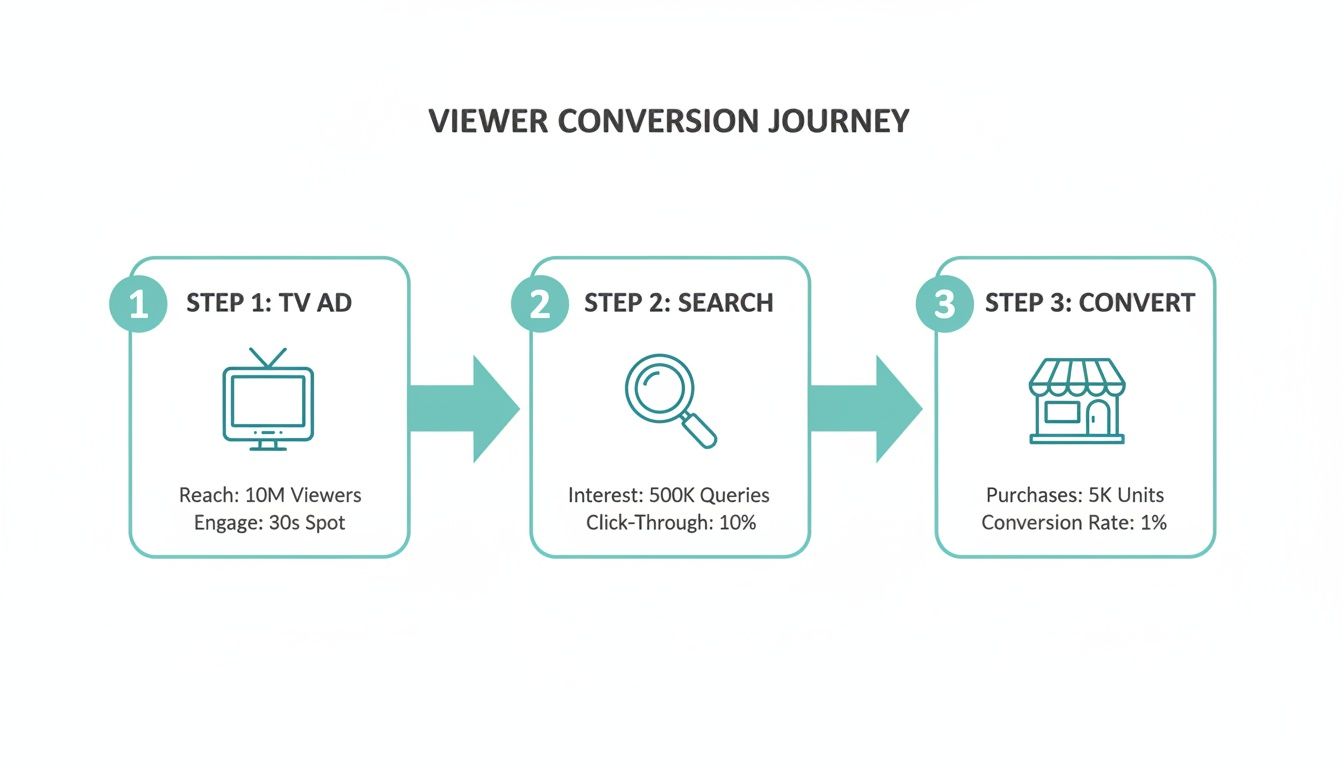
That "Search" step is the critical link between a potential customer seeing your ad and deciding to buy. It's also precisely where inconsistent NAP details break that chain, sending potential business to your competitors.
First, Establish Your Canonical NAP
Before you even think about auditing, you have to define your one "source of truth." This is the single, official, non-negotiable version of your business name, address, and phone number.
Imagine you're painting a house. You wouldn't use slightly different shades of white in every room, it would look sloppy and unfinished. Your business information works the same way. Even minor variations like "Street" vs. "St." can create confusion for both customers and search engines.
Your canonical NAP needs to be:
Exact: Decide on "Suite" or "Ste." or "#" and stick with it. No exceptions.
Complete: Use your full, legally registered business name. Don't shorten it on some platforms and use the full name on others.
Consistent: Choose one primary phone number and use that exact number everywhere.
How to Prioritize Your Audit
With your official NAP in hand, it’s time to start checking your live listings. Not all online directories are created equal, so you need to be smart about where you focus your energy. Start with the heavy hitters first.
Your goal is to find any listing that doesn't perfectly match your canonical NAP and fix it. We've put together a checklist to help you prioritize your audit, starting with the most critical platforms that directly impact your visibility and customer trust.
NAP Consistency Audit Checklist
This tiered approach ensures you’re spending your time where it will make the biggest difference first. Once you’ve tackled the critical Tier 1 platforms, you can work your way down the list.
Making the Fixes
Correct your website and business listings directly. See our guide to how to optimize your Google Business Profile for more calls.
For other directories, you may need to "claim" the listing first to gain editing access. If you find incorrect information on a smaller site where you can't claim it, you'll have to reach out to the site's administrator and request an update.
This entire process of finding, correcting, and creating consistent listings across the web is often called local citation building. Every correct citation acts like a vote of confidence for your business, while every incorrect one creates doubt.
It takes effort, but the payoff is huge. A consistent online presence ensures every potential customer, no matter how they find you, gets the right information and has a connected path to your door.
Tools and Best Practices for Long-Term NAP Management
Getting your business information correct everywhere isn't a one-and-done project. It's more like gardening, you can't just plant the seeds and expect a perfect harvest. You have to keep watering, weeding, and protecting your work.
In the same way, wrong information can quietly sprout back up across the web, and new directory sites appear constantly. Without a solid plan to manage it all, the trust you've worked so hard to build with Google and your customers can quickly fade.
Automating Your NAP Distribution
Let's be realistic: no small business owner has time to manually update hundreds of online directories. This is where local listing management software comes in, and it's a useful option. These platforms are your single source of truth for your business info.
You just enter your official Name, Address, and Phone number one time, and the software pushes that information out to a massive network of directories, data aggregators, and map services. It’s the simplest way to guarantee your business name, address, and phone must match everywhere, and it will save you a staggering amount of time.
These tools also keep watch for you over the long haul:
Inaccuracy Monitoring: They actively scan the internet for listings that don't line up with your official NAP and flag them for you.
Duplicate Suppression: They find and merge those confusing duplicate listings that can split your customer reviews and search engine authority.
Performance Reporting: They give you clear reports on how your online visibility is growing, so you can see the direct impact of your efforts.
By automating the distribution and monitoring of your business data, you create a powerful, self-healing system that defends your digital identity against the constant threat of bad data.
The Importance of an Internal Protocol
Great software is a huge help, but you also need a clear, simple process inside your own company for handling your business information. Everyone on your team, from a marketing intern to the person answering the phones, needs to know the one "official" version of your NAP.
This simple rule prevents those accidental mistakes, like an employee signing up for a new online tool using an old address or an abbreviated business name. For a deeper dive, check out our guide on local citation building and getting your business listed on every directory.
This kind of internal discipline is especially important as more businesses turn to Connected TV (CTV) advertising, where Adwave helps local companies get noticed. The global ad verification market is booming, largely because of CTV's growth and the critical need to stop ad fraud. Making sure your ad dollars are working is paramount. You can explore the market growth reports here to see the trend.
For a platform like Adwave, a verifiable and trustworthy business identity is absolutely essential. When a viewer sees your TV ad and then searches for you online, the perfect NAP match they find instantly validates the ad and proves you're a legitimate business. It creates that connected, confident experience that turns a viewer into a loyal customer.
Common NAP Mistakes That Sabotage Your Business
Even with the best of intentions, it's surprisingly easy to trip up on NAP consistency. These simple, often overlooked mistakes can create a ripple effect of confusion for both search engines and customers, quietly undermining your local marketing before it even gets going.
Let's start with a classic one: misusing call tracking numbers. They're great for measuring how well a specific ad campaign is working, but putting a tracking number on a core business listing, like your Google Business Profile, is a major misstep. This creates a direct conflict with your real phone number, telling Google two different stories and weakening its trust in your business information.
Another common pitfall happens after a big change, like moving your office or rebranding. You're busy updating your website and storefront, but what about the dozens of old listings scattered across the web? Each one with an outdated address becomes a digital dead end, sending potential customers on a frustrating goose chase.
Standardizing Every Detail
Inconsistencies often hide in the smallest details of your address. Have you ever written "St." on one directory and "Street" on another? Or maybe used "Suite 200" on your website but "#200" on your business’s Facebook page? These tiny differences are a bigger deal than you might think.
To an algorithm, 'St.' and 'Street' aren't the same. Each inconsistency creates a separate, weaker version of your business identity, diluting your authority and harming your local search ranking.
A perfectly consistent NAP is absolutely important when you're running high-visibility ads, like a TV campaign with Adwave. A powerful ad gets people to pull out their phones and search for you, but if your digital storefront is a mess, that hard-earned interest evaporates. The need for a verified, trustworthy online identity is only growing, especially as advertisers flock to Connected TV (CTV). For context, one study found mobile app video fraud shot up by 50% year-over-year, which is why advertising verification trends now heavily favor platforms with a bulletproof identity.
Fixing these small errors ensures the momentum from your Adwave ads translates into actual customers. Think of it as paving the road from their TV screen to your front door. This effort goes hand-in-hand with building a stellar online reputation, so be sure to check out our guide on getting more Google reviews to strengthen your local presence even further.
Your Top Questions About NAP Consistency, Answered
Let's tackle some of the most common questions I hear from business owners about getting their online information straight.
How Long Does It Take to See Results After Fixing My NAP?
Patience is key here, but you won't be waiting forever. Most businesses start seeing a noticeable lift in their local search rankings anywhere from a few weeks to three months after a major cleanup.
It’s a bit like starting a new fitness plan. You feel better after the first few workouts, but the real transformation comes from sticking with it. That’s how you build lasting authority and visibility in your local market.
Do Minor Differences Like 'St' vs 'Street' Really Matter?
Yes, they matter, a lot. It's one of the most common hangups I see. While you and I know that "St." is just an abbreviation for "Street," a search engine's algorithm often sees them as two completely different pieces of information.
Use the same business name, address, and phone number in every listing.
Can I Use a Call Tracking Number for Marketing?
This is a great question, and the answer requires a bit of strategy. You should not use a tracking number as the main phone number on your core business listings, especially your Google Business Profile. Your primary phone number on foundational profiles needs to be your real, local number to maintain perfect NAP integrity.
So, where do tracking numbers go? Use them for specific campaigns. For example, you can use dynamic call tracking numbers on dedicated landing pages or within your Google Ads. This lets you measure the performance of a specific ad or promotion without messing up the foundational SEO you’ve worked so hard to build.