Ready in minutes
AI builds your ad from a single prompt


December 02, 2025
Build buyer trust and compete with big dealerships using TV advertising for your independent lot.
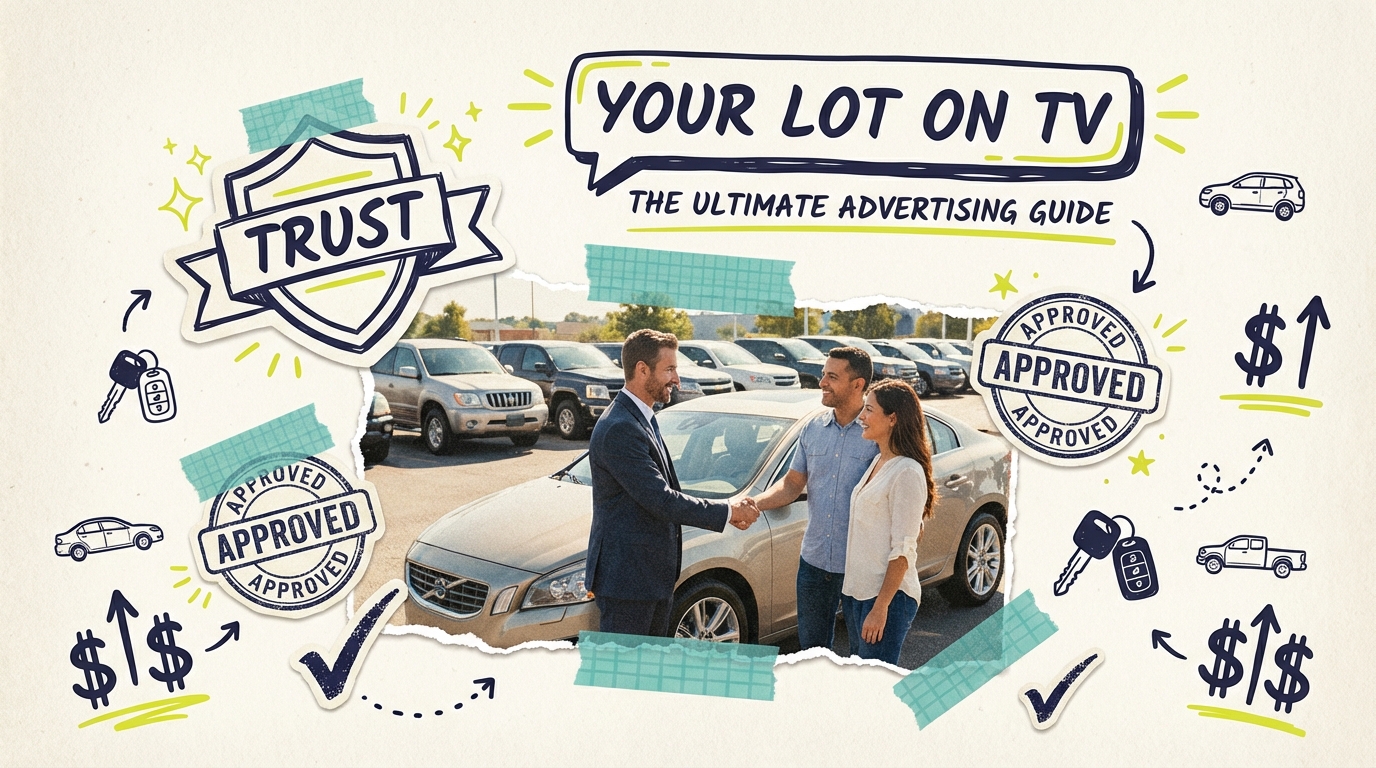
Used car buyers are skeptical by nature. They've heard the stories, seen the stereotypes, and approach every dealership with their guard up. The "sleazy used car salesman" trope has been cultural shorthand for decades. TV advertising directly counters that perception by positioning your dealership as an established, professional business that invests in reaching customers the way legitimate companies do.
When your lot appears on the same channels as major franchise dealerships and national brands, something shifts in how viewers perceive you. You're not just a name on a website or a sign on a corner lot. You're a real business that invests in reaching customers professionally. That credibility is invaluable when trust is the primary barrier between a potential buyer and a sale.
Independent dealers face unique challenges that TV advertising directly addresses. Unlike franchise dealerships backed by manufacturer marketing budgets, independent lots must build their own brand recognition from scratch. Unlike CarMax or Carvana with national awareness, local dealers must establish credibility within their specific market.

The used car market opportunity is substantial. Over 40 million used vehicles sell annually in the United States, dwarfing new car sales. Millions of buyers actively seek quality pre-owned vehicles at prices that make financial sense. Financing options through both dealers and external lenders expand the buyer pool significantly. And satisfied customers don't just buy once; they refer family members and friends who trust their recommendation.
Yet attracting used car buyers presents specific challenges that differ from other industries. Trust is the central issue for independent dealers. Buyers worry about hidden problems, unfair pricing, and high-pressure tactics. Competition from franchise dealers with bigger budgets puts independent lots at a visibility disadvantage. Many buyers default to CarMax or large dealer groups because of perceived safety, not because of better value. And overcoming deeply ingrained "sketchy used car lot" stereotypes requires actively demonstrating legitimacy rather than just claiming it.
TV advertising offers used car lots a powerful solution to these trust and visibility challenges. Being on TV signals you're an established, trustworthy business that plans to be around long-term. The "sketchy used car lot" stereotype dissolves when buyers see you on NBC, ESPN, Hulu, or their favorite streaming channels. You can compete with franchise dealers because TV levels the playing field; the viewer doesn't know your advertising budget, only that you're present on premium channels. Professional presentation counters negative perceptions directly and immediately. And you reach buyers before they start shopping online, so you're on their mental list when they begin researching.
The used car business is fundamentally built on trust. Buyers need to believe you're being honest about vehicle condition, fair about pricing, and reliable for any after-sale issues. TV advertising builds that trust faster and more effectively than any other marketing channel because it carries the implicit endorsement of the premium networks where your ads appear.
TV advertising for used car lots builds credibility and drives lot traffic through a straightforward process that doesn't require advertising expertise or large production budgets.

You share your website or social media with Adwave, and the platform's AI automatically gathers your lot imagery, inventory highlights, branding, and messaging. Within about two minutes, you see a professional 30-second commercial featuring your dealership. The ad looks like it cost thousands to produce, but the creation is free.
You then target car buyers by defining your geographic area. Most used car lots draw from a specific radius, typically 15-30 miles depending on market density and competition. You can target by ZIP code, city, or custom radius around your location. Beyond geography, you can focus on demographic segments most likely to be in-market for used vehicles.
Your ad runs on 100+ premium channels including NBC, Hulu, ESPN, ABC, CBS, and many others. Viewers see your commercial alongside content from trusted networks, building the association that elevates your perceived credibility.
You track results through the Adwave dashboard, monitoring impressions, geographic reach, and campaign performance. Correlate with your own lot traffic data to understand advertising impact.
Effective used car advertising reaches potential buyers before they commit to visiting a competitor or defaulting to a large dealer group.
Car buyers have practical limits on how far they'll travel to purchase, but those limits are larger than most retail categories. A buyer willing to save $1,000 might drive 45 minutes. Your geographic targeting should reflect your actual customer draw pattern, which you can determine by analyzing where recent customers came from.
Start with a core radius that matches your primary market, typically 15-25 miles. Consider expanding to capture buyers from areas with less dealer competition who might travel for better selection or pricing. Rural markets often draw from larger geographic areas than urban ones.
Used car buyers span a wide demographic range, but certain segments purchase more frequently. First-time buyers (often younger, possibly parents helping) represent a significant market. Growing families needing additional or larger vehicles are frequent buyers. Budget-conscious consumers prioritizing value over new-car status represent your core market. And buyers rebuilding credit through dealer financing represent a specific, targetable segment.
Define your ideal customer based on your inventory and financing capabilities, then target accordingly. If you specialize in trucks, target demographics that over-index for truck purchasing. If you focus on family vehicles, target households with children.
Some streaming platforms and ad networks offer targeting based on in-market signals, reaching people who have demonstrated used car shopping behavior through searches or website visits. This targeting can be extremely effective, as you're reaching people actively in the buying process rather than the general population.
Tax refund season (February-April) drives significant used car purchasing as buyers have cash for down payments. Back-to-school season matters for families needing transportation for new drivers. End of month and end of quarter often motivate buyers hoping for better deals. Advertising during these periods captures heightened intent.
TV advertising for your lot starts at just $50 with Adwave. That's significantly less than a single listing on CarGurus, Autotrader, or Cars.com, and reaches local buyers in a format that builds lasting brand recognition rather than competing for clicks on a comparison website.

Consider the value of each customer: a single used car sale might generate $1,000-3,000 in gross profit depending on your business model. One new customer acquired through TV advertising covers months of advertising costs. The math works strongly in favor of TV advertising when customer acquisition cost stays below a few hundred dollars.
For independent lots, smart budget allocation matters. A testing phase of $500-1,000 lets you gauge response and refine targeting before committing larger budgets. Ongoing campaigns of $1,500-3,000 monthly provide consistent visibility in competitive markets. During peak seasons like tax refund time, increasing budget captures heightened buyer activity.
At an average CPM of $25, $1,000 in advertising delivers approximately 40,000 ad views. In a market with 100,000 households, that means significant reach within your target audience. Consistent advertising builds frequency as the same viewers see your ads multiple times, reinforcing your brand with each exposure.
Adwave creates your commercial for free. You only pay to run it on premium channels where buyers are watching. Traditional TV production would cost $5,000-15,000 for a professional commercial; with Adwave, that barrier disappears entirely.
The most effective used car commercials differentiate you from stereotypes while highlighting genuine reasons to buy from you.
Lead with trust signals. Mention years in business if you have longevity. Reference customer testimonials or review scores. Highlight any certifications, warranties, or guarantees you offer. These elements immediately counter the "fly-by-night" perception that plagues the industry.
Show your actual lot and inventory. Viewers want to see that you're a real place with real vehicles. Drone footage of a well-organized lot, shots of clean inventory, and images of your facility establish physical presence and professionalism.
Feature your team if appropriate. The "faceless" used car lot feels less trustworthy than one where viewers see actual people. A brief appearance from the owner or sales team humanizes your business and creates accountability.
Address the trust issue directly in messaging. "We're not the used car lot your dad warned you about" acknowledges the stereotype while differentiating from it. "Every vehicle inspected and guaranteed" speaks directly to buyer concerns about hidden problems.
Include a clear call to action. Whether it's visiting for a test drive, checking online inventory, or calling for information, tell viewers specifically what to do next.
Used car lot advertising success shows through metrics that connect advertising activity to sales results.
Track lot traffic increases during campaigns. Compare foot traffic and inquiry volume to baseline periods to understand advertising impact. Digital traffic counters or sales team observations provide this data.
Monitor lead quality and source. Train your team to ask every visitor and caller how they heard about you. "I saw your commercial" provides direct attribution. Track whether TV-sourced leads close at similar or better rates than other sources.
Watch for increased web traffic and online inventory views. Even though TV primarily drives lot visits, expect digital engagement to increase during campaigns as viewers research you online before visiting.
Calculate cost per acquisition by dividing advertising spend by new customers acquired during campaign periods. For most used car lots, acquiring a new customer for $100-300 represents strong ROI given the profit per vehicle sold.
Compare advertising cost to listing platform costs. If you're spending $2,000 monthly on Cars.com and $1,500 on TV advertising, track which source generates more quality traffic and closed sales relative to cost.
The most common mistake used car dealers make with TV advertising is treating it like digital advertising and expecting immediate measurable response. TV builds brand awareness and trust over time. A two-week campaign might generate some response, but consistent advertising over months generates compounding returns as recognition builds.
Another mistake is neglecting the trust message. Generic "great deals, huge selection" messaging doesn't differentiate you or address the fundamental buyer concern. Lead with trust and credibility, then discuss inventory and pricing.
Some dealers target too broadly, reaching everyone in a metro area regardless of likelihood to purchase. Precision targeting costs the same as broad targeting but delivers impressions to people more likely to become customers.
Don't ignore frequency in favor of reach. Reaching 100,000 people once each is less effective than reaching 25,000 people four times each. Build frequency within your target audience rather than spreading thin.
Finally, don't let your ad look like the stereotypes you're trying to escape. Flashing text, aggressive voiceover, and "crazy" pricing gimmicks reinforce negative perceptions rather than building trust. Professional presentation differentiates you from competitors still using outdated tactics.
Used car purchasing follows seasonal patterns that smart advertising amplifies. Tax refund season from February through April represents the biggest opportunity as buyers have cash for down payments. Back-to-school in August drives demand for vehicles for new drivers and college students. End-of-year holidays see reduced traffic but motivated buyers. Understanding these patterns lets you increase investment when buying intent peaks and maintain presence during slower periods.
Independent dealers across the country are discovering what major dealerships have known for decades: TV advertising builds the trust and visibility that drives lot traffic. The difference now is that technology has made it accessible at budgets that make sense for independent operations.
Your dealership offers quality vehicles and fair deals. TV advertising lets you demonstrate that to skeptical buyers before they ever visit your lot. By the time they walk onto your property, they've already developed positive associations with your brand. That's a fundamentally different conversation than convincing a cold visitor who walked in off the street.
The playing field has leveled. The same streaming platforms where national brands advertise are now accessible to your independent lot. The same professional commercial quality is available through AI generation at no production cost. The only difference is whether you decide to show up.
Create your first TV ad free and see what your dealership looks like on the big screen. The next buyer who walks onto your lot might already know your name.
TV advertising helps used car lots build the credibility and trust that customers need when making vehicle purchases. The used car industry has trust challenges, and TV advertising establishes you as a legitimate, professional operation. Many used car dealers report that TV-driven customers arrive more confident and ready to buy.
Emphasize trustworthiness, selection, and value. Show your actual inventory and professional facilities. Highlight what makes you different: vehicle inspections, warranties, financing options, or customer service policies. Address common buyer concerns directly. Build confidence that customers will get a quality vehicle and fair deal.
Tax refund season (February through April) provides significant purchasing power. Year-end and model year transitions create interest. Back-to-school drives demand for college student vehicles. Maintain year-round presence since vehicle needs arise unpredictably. Promote specific inventory events or financing offers when available.
Track showroom traffic and test drives during campaign periods. Ask customers how they heard about you. Monitor website inventory page views during advertising. Calculate cost per vehicle sold from TV-attributed traffic. Compare average transaction values for TV-driven customers versus other sources.