Ready in minutes
AI builds your ad from a single prompt


August 01, 2025
What happens when you put $50 into five different marketing channels (one of them will surprise you)
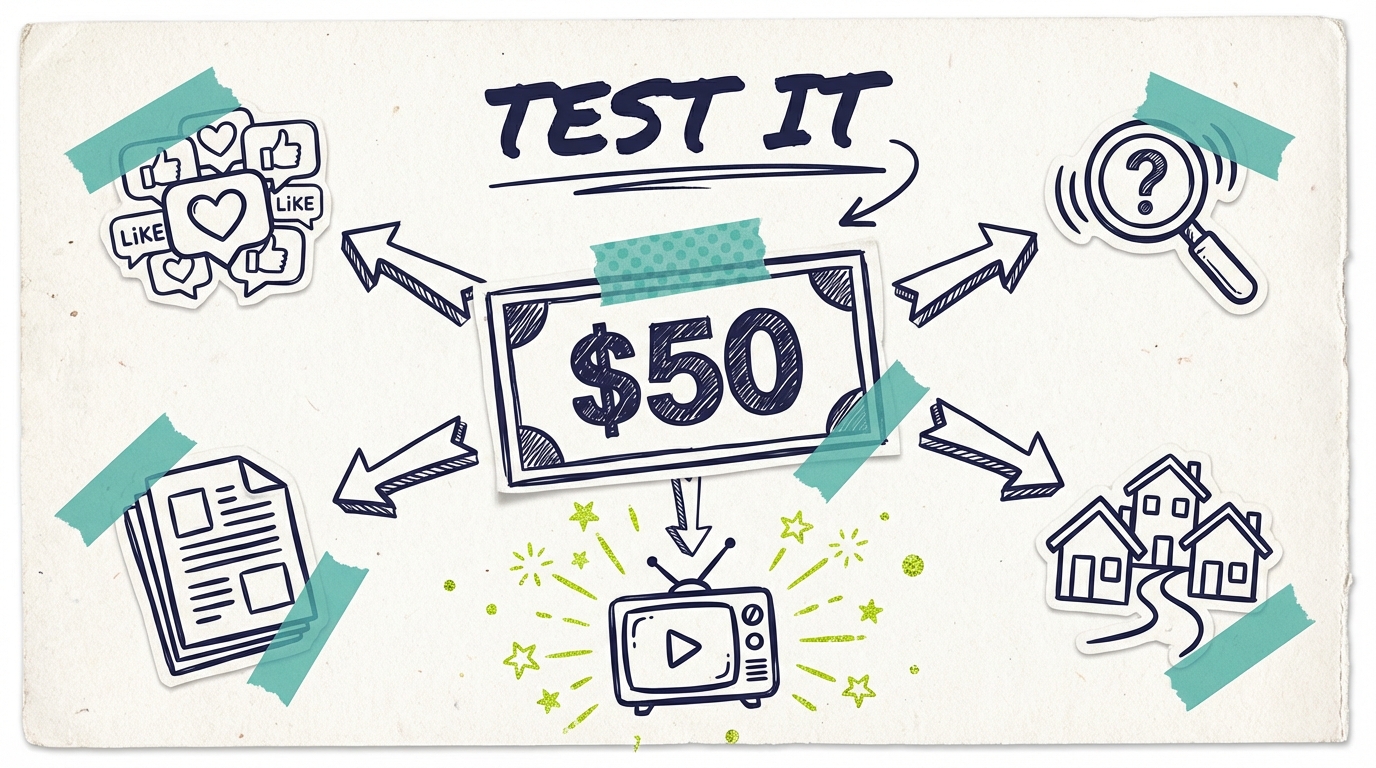
What if you could test five different marketing channels, each for just $50?
Most small business owners either stick with what they know (even when it stops working) or make big bets on new channels that may or may not pay off. Neither approach is smart when you're working with a limited budget.
Here's a better way: run small, cheap marketing ideas tests across multiple channels, see what actually works for your business, then scale the winners. I put $50 into five different channels to see what happened. One of the results surprised me.
The setup:
$50 budget per channel (total: $250)
2-week test period each
Same business type for fair comparison: a local service business
Consistent messaging across channels
What we measured:
Reach/impressions
Engagement (clicks, interactions)
Leads generated
Cost per lead
Let's walk through each channel.
What we ran: A local awareness campaign targeting adults 25-54 within 15 miles, promoting the business with a "Learn More" call-to-action.
Results:
Reach: 3,200 people
Clicks: 47
Leads: 2
Cost per lead: $25
Verdict: Solid reach for the budget. The targeting worked well for geographic focus. However, lead quality was mixed, and CPMs continue to rise.
Best for: Businesses with visually appealing products or services, younger target demographics, and those already comfortable with the ads manager.
What we ran: Local Services Ads for a service-based business, targeting nearby zip codes.
Results:
Impressions: 890
Leads: 3
Cost per lead: $16.67
Verdict: Lower reach but higher intent. People searching for your service are ready to buy. The leads were more qualified than social media leads.
Best for: Service businesses where customers actively search for solutions (plumbers, lawyers, cleaners, contractors).

What we ran: A sponsored post targeting neighbors within a 10-mile radius, highlighting local ownership and community connection.
Results:
Reach: 1,800 neighbors
Engagement: 23 interactions
Leads: 1
Cost per lead: $50
Verdict: Highly local reach with community trust factor. Engagement was positive but conversion was lower. Works better for certain business types.
Best for: Hyperlocal businesses where "neighbor" trust matters (home services, pet care, childcare).
What we ran: Promoted a helpful, non-salesy post in local Facebook groups and community forums, with business mentioned naturally.
Results:
Reach: 2,400 (organic + boosted)
Engagement: 67 interactions
Leads: 2
Cost per lead: $25
Verdict: High engagement when content is genuinely helpful. Feels less like advertising. Requires more creative effort but builds goodwill.
Best for: Businesses with expertise to share (advice, tips, how-to content that helps the community).
Yes, you can actually run TV commercials for $50.
What we ran: A 30-second commercial created by Adwave's AI from the business website, targeting viewers within 15 miles on streaming platforms like Hulu, Peacock, and Roku.
Results:
Impressions: 2,000
Brand searches: 12 (tracked via Google Search Console)
Website traffic increase: 18%
Direct leads: 1
Cost per impression: $0.025
The surprise factor: A local business appeared on the same networks as major national brands. For the cost of a pizza dinner.
Verdict: Outstanding for brand awareness and credibility. The "I saw you on TV" effect is real. Lower direct-response than search, but the trust-building is unmatched.
Best for: Local businesses wanting to build brand recognition, stand out from competitors, and create "legitimacy" perception.

Here's how the five channels compared:
Google Local Services Ads: 890 reach, 3 leads, $17/lead. Best for direct response.
Facebook/Instagram: 3,200 reach, 2 leads, $25/lead. Best for broad awareness.
Boosted Local Content: 2,400 reach, 2 leads, $25/lead. Best for community trust.
Nextdoor: 1,800 reach, 1 lead, $50/lead. Best for hyperlocal businesses.
[Streaming TV](https://adwave.com/resources/what-is-connected-tv-advertising/): 2,000 impressions, 1 lead, $50/lead. Best for brand credibility.
For direct leads: Google Local Services won with the lowest cost per lead and highest intent.
For awareness and reach: Facebook/Instagram delivered the most eyeballs.
The unexpected insight: TV advertising, despite producing fewer direct leads, generated the most brand searches and website traffic increases. People who saw the TV ad went looking for the business afterward.
The "I saw your ad on TV" comments from customers were worth noting. That credibility boost doesn't show up in a cost-per-lead calculation, but it matters.
Ready to experiment? Here's how:
Start with 2-3 channels. Don't test everything at once. Pick channels that match your business type and goals.
Measure what matters for each channel:
Search ads → leads and cost per lead
Social ads → reach and engagement
TV ads → brand searches and website traffic
Test for at least 2 weeks. One week isn't enough data. Give each channel time to perform.
Track "how did you hear about us?" Sometimes the best measurement is simply asking customers.
When to scale up: If a channel delivers results at $50, test again at $100-200. If results hold, you've found a winner. If a channel fails at $50, don't throw more money at it.

The biggest surprise from this experiment: TV advertising is now accessible at small-business budgets. And it delivers something other channels can't: instant credibility.
With Adwave, you can create a professional TV commercial and run it on 100+ premium channels starting at $50. No production budget required. No media buying expertise needed.
Start your $50 TV test and see what happens when your business appears on the biggest screen in the house.
Yes, when spent strategically. While $50 won't create massive reach, it can test whether a channel works for your business, reach hundreds or thousands of people in your local area, and generate learnings that inform larger investments. Think of small-budget testing as market research that might also drive some results. The insights gained often prove more valuable than the immediate response.
Focus your $50 on a single channel rather than splitting it. Options include: $50 on hyper-local Facebook or Instagram ads targeting your immediate area, $50 on Google Ads for high-intent local keywords, $50 on CTV advertising to test TV as a channel, or $50 on boosting your best-performing social content. Each option teaches you something about what works for your business.
For digital channels, use built-in tracking for impressions, clicks, and conversions. For all channels, watch for changes in website traffic, phone calls, and walk-ins during your test period. Ask new customers how they found you. Compare results to baseline periods without advertising. Even with small budgets, you can learn whether a channel shows promise worth scaling.
Scale a channel when you see positive signals like engaged traffic, inquiries, or sales that suggest the approach works. If $50 drives three new customers and each customer is worth $200, the math suggests spending more would be profitable. Be willing to abandon channels that show no promise after adequate testing, but don't give up too quickly since small tests may not reach statistical significance.
A test with no results still provides valuable information. Consider whether the channel might work with different targeting, messaging, or timing. Some channels need larger investments to reach effective frequency. Not every channel works for every business, and learning that quickly saves money in the long run. Try a different approach before concluding the channel doesn't work for you.