Ready in minutes
AI builds your ad from a single prompt


May 30, 2025
CTV CPMs average $25, but range from $15-35 depending on targeting and platform.
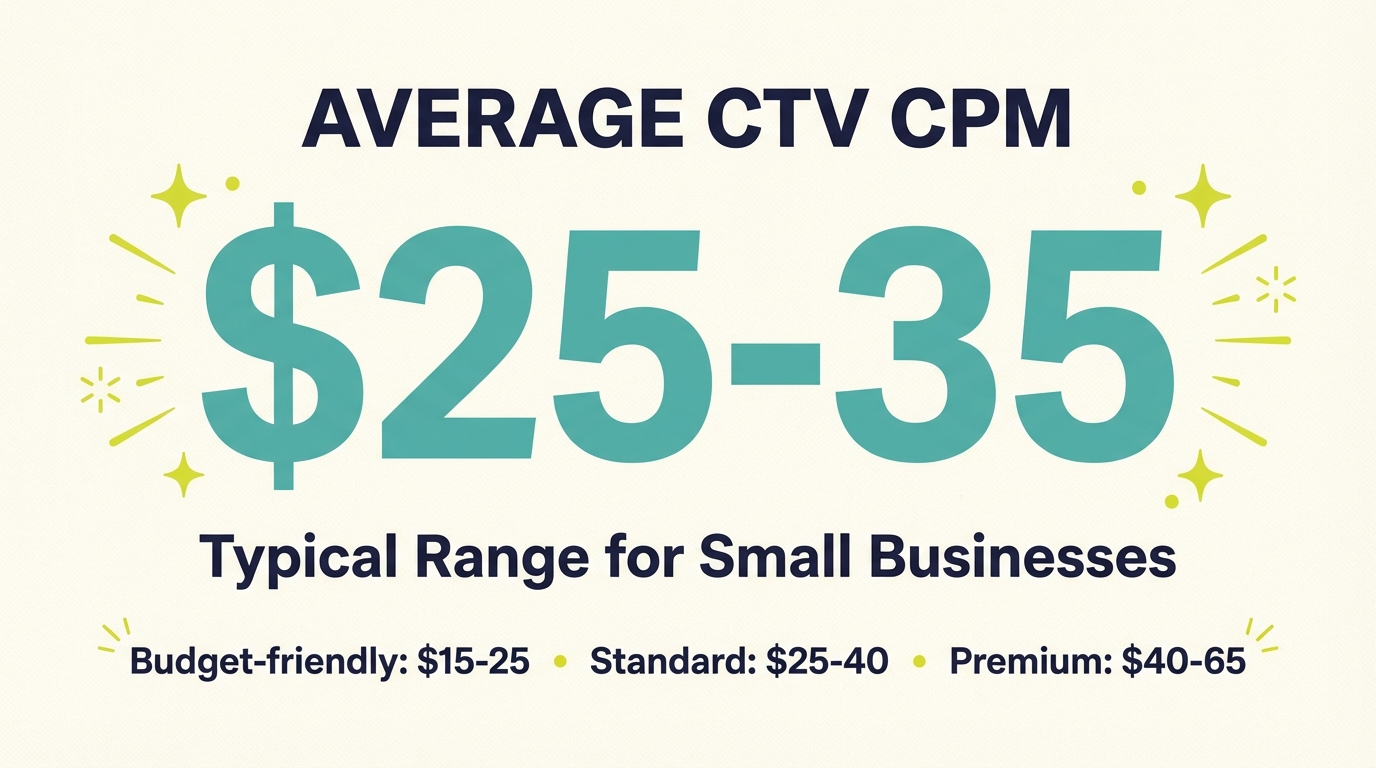
$25
Average CTV CPM for small businesses
$15-35
Typical CPM range through aggregated platforms
90%+
CTV video completion rates
The average CPM for CTV advertising ranges from $20 to $40, with most campaigns falling around $25 CPM according to industry analysis from AI Digital. This positions CTV advertising between traditional broadcast television (higher CPMs) and digital display advertising (lower CPMs). It's an attractive middle ground for advertisers seeking TV-quality placements with digital-level targeting capabilities.
Understanding CTV CPM is essential for any business considering streaming TV advertising. Unlike traditional television where you pay for time slots regardless of who watches, CTV advertising operates on a performance-based model. You pay for actual impressions delivered to targeted audiences. This fundamental shift in pricing mechanics changes how businesses should think about TV advertising budgets and expected returns.
For small businesses historically priced out of television advertising, CTV's CPM-based pricing creates new opportunities. With platforms like Adwave offering minimum budgets as low as $50 and average CPMs around $25, a small business can reach several thousand targeted viewers for less than the cost of a single direct mail campaign.
CTV CPM rates vary significantly based on platform, targeting specificity, ad format, and market conditions. Here's a comprehensive breakdown of current CPM benchmarks across the CTV ecosystem.
According to Simulmedia's TV advertising cost guide, here's what advertisers are paying across major streaming platforms:
Netflix charges $20-30 CPM for programmatic buys and $45-65 CPM for direct buys. Hulu ranges from $10-30 CPM depending on targeting and inventory type. Amazon Prime Video runs $25-60 CPM based on targeting specificity. Peacock offers $15-35 CPM for programmatic inventory. Paramount+ starts around $7 CPM base, increasing with targeting. YouTube CTV averages $20-25 CPM for television screen placements. Roku charges $20-35 CPM through the Roku Channel. Tubi and Pluto (FAST services) run $15-25 CPM for free ad-supported tiers.
Keynes Digital's analysis found that the median CPM for CTV ads falls between $20-35, with premium inventory and advanced targeting pushing rates higher. This compares to broadcast and cable linear television at $10-15 CPM, though linear TV typically requires much higher minimum commitments.

The level of targeting precision directly impacts CPM rates.
Broad targeting delivers the lowest CPMs. Run-of-network placement costs $15-25 CPM. Basic demographic targeting runs $20-30 CPM. Geographic targeting at the DMA level costs $20-30 CPM.
Standard targeting falls in the mid-range. Behavioral and interest targeting costs $25-40 CPM. Contextual targeting runs $25-35 CPM. Multiple demographic layers cost $30-45 CPM.
Advanced targeting commands premium CPMs. First-party data matching costs $35-50 CPM. Lookalike audiences run $30-45 CPM. Purchase intent signals cost $40-60 CPM. Retargeting and remarketing runs $35-55 CPM.
Paramount's advertising insights confirm this pattern. Campaigns starting at around $7 CPM typically increase as advertisers apply more refined targeting parameters.
The CTV advertising market is experiencing significant CPM dynamics.
From 2023-2024, premium CPMs ranged from $35-50 for premium inventory. Limited ad-supported streaming inventory and strong advertiser demand drove prices higher.
From 2024-2025, CPM compression occurred as supply expanded. According to Marketing Architects, CTV faces an "inventory glut" driving CPMs lower. Netflix, Disney+, and Amazon Prime Video launched ad tiers. More FAST inventory became available. Average CPMs are now trending toward $25-35.
Projected for 2025-2026, stabilization with premium segmentation is expected. Base CPMs are settling around $20-25. Premium targeting and placement commands $40-60. Greater differentiation between inventory quality levels is emerging.
This supply expansion is good news for small business advertisers. Increasing inventory availability puts downward pressure on CPMs while maintaining access to premium streaming audiences.
Understanding what drives CTV CPM helps you optimize your advertising investment and set realistic expectations for campaign performance.

Time of year matters significantly. Q4 (October-December) typically sees CPMs increase 20-40% due to holiday advertising competition. Political advertising years see additional spikes in swing-state markets. January often offers the lowest CPMs as advertisers pause after holiday spending.
Day and time targeting affects pricing. Prime time (7 PM - 11 PM) commands premium CPMs, often 30-50% higher than daytime inventory. Restricting to specific dayparts reduces available inventory and increases cost per impression.
Device specificity raises costs. Targeting only smart TVs (excluding mobile and desktop streaming) typically increases CPM by 15-25% because TV screen inventory is more limited and more valuable.
Content genre targeting costs more. Advertising on specific content categories (sports, news, premium drama) typically costs 20-40% more than run-of-network placements due to limited inventory and higher engagement.
Audience exclusivity commands premiums. First-party data segments, custom audiences, and competitive conquesting all command premium CPMs because they represent specific, valuable viewer pools.
Flexible timing reduces costs. Allowing campaigns to run across all dayparts and days of week provides access to lower-cost inventory that advertisers with time restrictions can't utilize.
Broader targeting opens inventory. Geographic targeting at the national or regional level versus hyper-local opens more inventory and reduces CPM. Similarly, broader demographic targeting reduces competition for limited audience segments.
Longer campaign flights earn discounts. Committing to multi-week or multi-month campaigns often earns CPM discounts of 10-20% compared to short burst campaigns.
Off-peak timing saves money. Running campaigns in Q1 (January-March) or outside major advertising events can reduce CPMs by 15-25% compared to peak seasons.
Programmatic buying accesses better rates. Programmatic platforms often access inventory at lower CPMs than direct buys, though premium inventory may require direct relationships.
Understanding CPM helps translate advertising costs into real numbers.
At $25 CPM (Adwave average): $50 budget delivers 2,000 impressions. $100 budget delivers 4,000 impressions. $500 budget delivers 20,000 impressions. $1,000 budget delivers 40,000 impressions.
At $35 CPM (premium targeting): $50 budget delivers approximately 1,430 impressions. $100 budget delivers approximately 2,860 impressions. $500 budget delivers approximately 14,300 impressions. $1,000 budget delivers approximately 28,570 impressions.
At $15 CPM (FAST/broad targeting): $50 budget delivers approximately 3,330 impressions. $100 budget delivers approximately 6,670 impressions. $500 budget delivers approximately 33,330 impressions. $1,000 budget delivers approximately 66,670 impressions.
For local businesses, the key insight is that even modest budgets can generate meaningful impression volumes. A small business TV advertising campaign of $500 delivers tens of thousands of impressions to targeted local audiences.

CTV CPM understanding helps you make informed decisions about your advertising mix and budget allocation.
How does CTV compare to other advertising options?
CTV versus social media: Facebook and Instagram CPM runs $8-20. TikTok CPM runs $10-25. CTV CPM runs $20-40. Social media offers lower CPMs but typically lower engagement and attention. CTV delivers premium video on the largest screen in the home, with higher completion rates and brand impact.
CTV versus traditional TV: Local cable CPM runs $5-15 but requires high minimum commitments. National broadcast CPM runs $20-50. CTV CPM runs $20-40. CTV matches or beats traditional TV CPM while offering better targeting, no minimum commitments on some platforms, and measurable results.
CTV versus digital video: YouTube (all devices) CPM runs $10-30. Pre-roll video CPM runs $15-35. CTV CPM runs $20-40. CTV commands a premium over general digital video due to the larger screen, lean-back viewing environment, and higher completion rates.
CPM alone doesn't tell the complete story. Consider efficiency metrics.
Video completion rate matters. CTV delivers 90-95% video completion rates, compared to 40-60% for digital video. A $30 CPM with 95% completion may be more efficient than a $20 CPM with 50% completion.
Attention metrics favor CTV. TV viewers are more attentive than mobile users. Research suggests CTV ads receive 3-5x more attention than mobile video ads, making the higher CPM worthwhile for brand messaging.
Brand lift is stronger. Studies consistently show CTV delivers 2-3x the brand lift of digital display advertising, partially justifying the CPM premium.
Attribution windows are longer. CTV advertising impact often appears over longer windows (weeks to months) compared to direct-response digital channels. The true value may not be captured by immediate conversion tracking.
CTV advertising delivers the best ROI for brand awareness campaigns where the premium format builds awareness efficiently. Local targeting ensures budget reaches relevant audiences. Mid-funnel influence is CTV's sweet spot. Trust-dependent purchases benefit from TV credibility. Competitive differentiation comes from TV presence setting you apart from digital-only competitors.
CTV may not be the best choice for pure direct response where lower-CPM channels may drive more immediate clicks. Very narrow niches may not have sufficient scale. Short-term promotions may not allow enough build time.

Understanding CTV CPM helps you maximize the value of your streaming TV advertising investment.

Use programmatic platforms. Self-serve platforms like Adwave often offer lower CPMs than direct platform buys because they aggregate inventory across multiple sources.
Embrace flexibility. Allow campaigns to optimize across dayparts, days of week, and devices. The more flexibility you provide, the more efficiently the system can find quality impressions at lower costs.
Test FAST channels. Free ad-supported streaming services like Tubi and Pluto TV offer quality inventory at lower CPMs than premium subscription services. Don't assume lower CPM means lower quality audiences.
Consider timing. Launch campaigns in Q1 when CPMs are typically lowest. Avoid major tentpole events (Super Bowl, Olympics, elections) when advertiser demand spikes.
Start broad, then narrow. Begin with broader targeting to establish baseline performance, then narrow based on data. Starting too narrow limits learning and inflates CPM.
Invest in creative quality. A well-produced ad that engages viewers generates more value per impression. The production cost is a one-time investment that improves every impression's effectiveness.
Use sequential messaging. Platforms that support sequential creative allow you to tell a story across multiple impressions, increasing the impact of each view.
Implement frequency caps. Prevent wasted impressions by capping how often the same household sees your ad. Most campaigns benefit from 3-5 frequency caps per week.
Add QR codes. QR codes on CTV ads enable direct response tracking, helping attribute conversions to TV exposure and demonstrating value beyond impressions.
Measure beyond impressions. Track website visits, search volume, and conversion rates during campaign periods. CTV's value often appears in these downstream metrics rather than click-through rates.
CTV CPM trends reflect broader shifts in the advertising landscape that create opportunities for businesses of all sizes.
Traditional TV advertising required massive budgets due to high minimum commitments, production costs, and inefficient targeting. CTV changes each of these factors.
Lower minimums have dropped from $5,000+ to $50 on some platforms. AI eliminates production costs by creating professional ads from existing assets. Precise targeting means you pay only to reach your specific audience. Measurable results let you track impressions, completion rates, and downstream impact.
This democratization means small businesses can now access TV's brand-building power alongside the largest advertisers. A local restaurant can appear on the same screens as McDonald's, reaching the same premium-viewing environment.
The CTV market is maturing rapidly. According to Mason Interactive's 2025 trends analysis, CPM trends are shifting as the market evolves.
Supply growth from major streaming services adding ad-supported tiers creates more inventory. Measurement improvement drives confidence in CTV investment. Fraud reduction decreases wasted spend. Standardization of common metrics and buying processes reduces friction.
These trends generally favor advertisers through more competitive pricing and clearer performance metrics.
As digital advertising faces increasing challenges with ad blockers, privacy restrictions, and attention fragmentation, CTV's value proposition strengthens.
No ad blockers exist on CTV. The full-screen format eliminates competition with other content on screen. The sound-on environment ensures audio messaging reaches engaged viewers. The lean-back context means viewers are in a relaxed, receptive state.
These factors suggest CTV CPMs may maintain their premium position even as supply increases, because the quality of the impression justifies the cost.

Industry analysts and advertising executives have noted the evolving CTV CPM landscape.

AI Digital's comprehensive guide notes that "the high CPMs of connected TV ads (often $25-65 per thousand impressions) create unique dynamics in the advertising marketplace." The guide emphasizes that while CPMs may seem high compared to digital display, the quality of impressions delivered justifies the investment for brand-focused advertisers.
Marketing Architects' analysis observed that "CTV media has traditionally carried premium prices, with higher costs per thousand impressions compared to both linear TV and true digital channels." However, the article notes that supply expansion is creating opportunities for advertisers to access quality inventory at more competitive rates.
The consensus among industry observers is that CTV CPMs are normalizing as the market matures. This creates better value for advertisers while maintaining the premium positioning that reflects the medium's effectiveness.
A "good" CPM depends on your goals and targeting. For broad awareness campaigns, CPMs of $20-25 represent good value. For highly targeted campaigns reaching specific audiences, CPMs of $30-45 may be appropriate given the precision. The key metric is efficiency: are you reaching the right people at a cost that delivers positive ROI? With platforms like Adwave averaging $25 CPM, most small businesses can achieve meaningful reach within reasonable budgets.
CTV CPM is higher because you're paying for premium inventory. You get full-screen video ads on the largest screen in the home. Ads are viewed in a lean-back environment with sound on. Viewers complete over 90% of CTV ads compared to less than half of digital video ads. The attention quality, brand safety, and lack of ad blocking justify the premium.
Divide your budget by the CPM, then multiply by 1,000. For example: $500 budget ÷ $25 CPM × 1,000 = 20,000 impressions. This tells you approximately how many times your ad will be shown. Keep in mind that impressions don't equal unique viewers. Frequency caps and campaign duration affect how many unique households you'll reach.
Generally, yes, if the targeting improves relevance. Paying $35 CPM to reach your exact target audience is usually more efficient than paying $20 CPM to reach a broader group where half aren't potential customers. However, don't over-narrow your targeting. Test to find the optimal balance between reach and precision for your specific business.
CTV CPM ($20-40) is often comparable to or lower than national broadcast TV ($20-50) but typically higher than local cable ($5-15). However, traditional TV usually requires minimum commitments of thousands of dollars monthly. CTV platforms accept budgets starting at $50. For small businesses, CTV's lower minimums make it more accessible despite similar or higher CPMs.
Key statistics on CTV CPM and advertising costs:
The typical CTV CPM range is $20-40 according to industry benchmarks. The average CTV CPM on platforms like Adwave is $25. Premium streaming direct-buy CPMs for Netflix and similar platforms run $45-65. Base programmatic CPM before targeting is $7-15. CTV video completion rates average 90-95%. Q4 CPM increases due to seasonal demand run 20-40%. The minimum campaign budget on accessible CTV platforms is $50. Brand lift advantage of CTV versus digital display is 2-3x. Linear TV CPM for comparison runs $10-15.
Understanding CTV CPM is the first step toward leveraging streaming TV advertising for your business. With CPMs averaging around $25 and minimum budgets as low as $50, CTV has never been more accessible for businesses of all sizes.
Adwave makes CTV advertising simple. Create a professional TV commercial in minutes using AI. Set your targeting and budget. Launch your campaign across 100+ premium streaming channels. No agency required. No production costs. No long-term commitments.