Ready in minutes
AI builds your ad from a single prompt


January 18, 2026
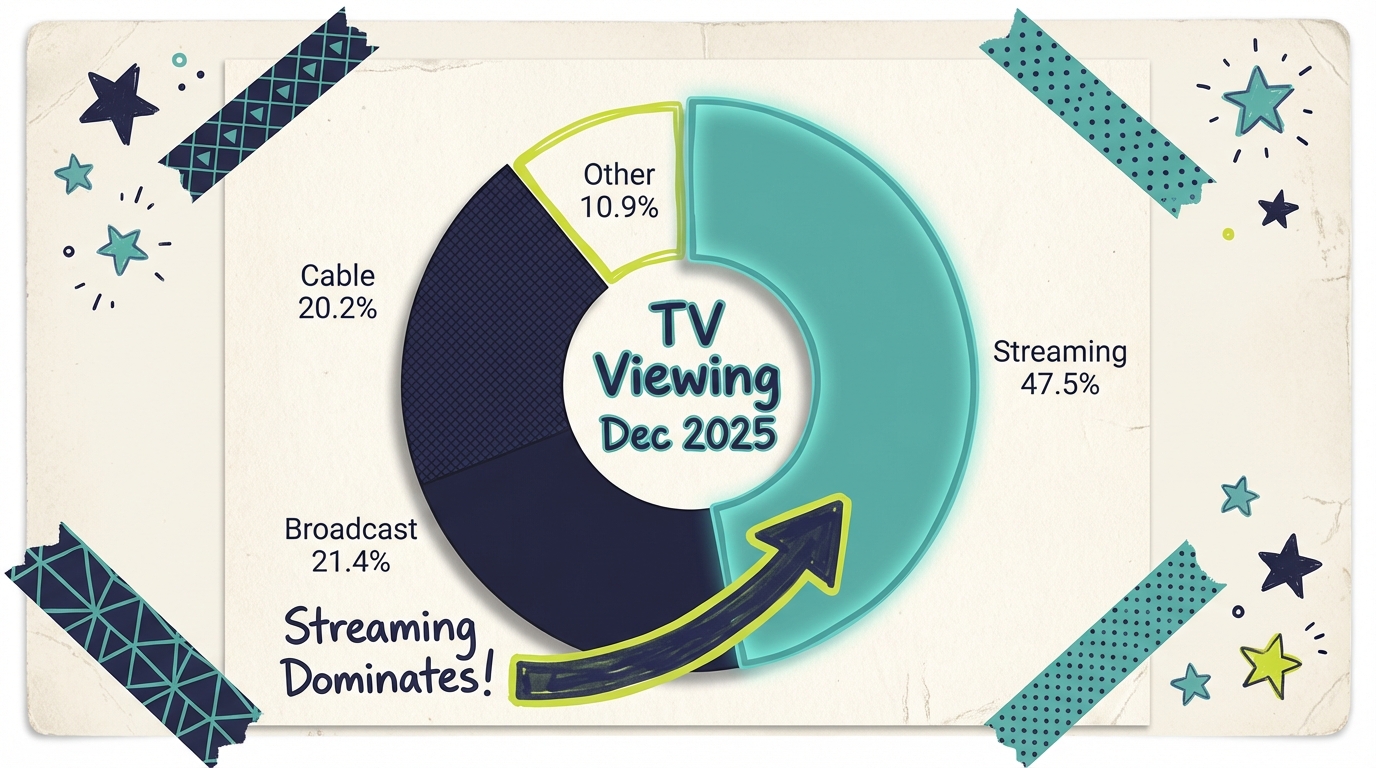
47.5%
Streaming's share of total U.S. TV viewing
20.2%
Cable's share (record low)
+4.1pts
Streaming gain year-over-year
December 2025 delivered streaming's most dominant month ever, shattering records that had stood for just five months.
Based on Nielsen's Gauge data and industry reporting:
Streaming: 47.5% of total TV viewing
Beat the previous record of 47.3% set in July 2025
Largest share of TV ever reported in Nielsen's Gauge history
Includes Netflix, YouTube, Hulu, Prime Video, Disney+, and dozens more
Growing share month over month and year over year
Broadcast: 21.4% of total TV viewing
Relatively stable compared to cable's decline
NFL and holiday specials provided support
Local and network news remain anchors
Still skews older demographic
Cable: 20.2% of total TV viewing
Lowest share in Nielsen Gauge history
Down significantly from 24%+ just one year ago
Sports and news remain strongest categories
Continues steady, accelerating decline
Other (gaming, DVD, etc.): 10.9%
Includes gaming console use on TV
DVD and Blu-ray playback
Other connected device usage

December 25, 2025 rewrote the record books for streaming viewership. According to The Wrap's analysis:
55.1 billion viewing minutes on streaming platforms, shattering the previous record by 8%
54% of all TV viewing went to streaming, the highest single-day share ever recorded
Netflix and Prime Video together commanded 22.5% of total TV usage on Christmas Day
Second time in history that daily streaming exceeded 50 billion minutes
The first 50%+ day had occurred just 12 days earlier, on December 13, when streaming captured 50.4% of daily TV. Two 50%+ days in one month signals that streaming's dominance isn't a holiday anomaly but the new normal.
The acceleration from December 2024 to December 2025 is striking:
Streaming gained over 4 percentage points of share in a single year, almost entirely at cable's expense. Cable lost roughly the same amount streaming gained. Broadcast held relatively steady, protected by NFL football and holiday programming.
For context, streaming has gained approximately 20 percentage points of share since 2021, when it represented roughly 27% of TV viewing. Cable has lost about 15 percentage points over the same period.
Within streaming, viewership concentrates on a handful of major platforms:
YouTube's 12.7% share alone exceeds cable's entire 20.2%. Netflix's 9% share represents nearly half of cable's total. The top two streaming platforms combined (21.7%) now exceed all of cable viewing.
---
Understanding who watches what helps advertisers make informed decisions about where to invest.
Cable viewers tend to be:
Older (median age 55+)
Often maintaining service for specific channels (ESPN, local news)
Higher concentration in suburban and rural areas
Declining in number each month as cord-cutting continues
Streaming viewers span all demographics but skew:
Younger (median age 35-40)
Higher adoption among urban and suburban households
All income levels, with particularly strong penetration among higher incomes
Growing as cord-cutters and cord-nevers become the majority
Broadcast viewers:
Oldest demographic (median age 60+)
Concentrated around major events (NFL, news, award shows)
Strong local news viewership
Over-the-air antenna users growing as an alternative to cable
The demographic implications are clear: if your target customer is under 50, streaming is where you'll find them. Cable's audience is not only smaller but older and continuing to shrink.

A growing majority of American households are now streaming-first or streaming-only:
Cord-cutters: Former cable subscribers who cancelled, now ~35% of households
Cord-nevers: Adults who never subscribed to cable, especially prevalent under 35
Cord-shavers: Reduced cable packages supplemented with streaming
Together, these groups represent over half of American households. They cannot be reached through cable advertising at all. The only way to reach them on the TV screen is through streaming.
Prime time (8 PM - 11 PM):
Streaming dominates decisively with 50%+ share
Highest total viewing hours of the day
Most valuable advertising inventory
Daytime (12 PM - 5 PM):
Streaming competitive with cable
Work-from-home viewers boost streaming
Cable maintains some daytime programming audience
Morning (6 AM - 12 PM):
Broadcast leads with morning news
Cable news draws substantial audiences
Streaming growing for background viewing
For advertisers, streaming's prime-time dominance is particularly significant. This is when the most viewers are watching and when advertising typically delivers the greatest impact.
---
The 47.5% vs 20.2% split isn't just a statistic. It represents a fundamental shift in where advertising dollars should go.
Cable advertising faces a compounding challenge:
Shrinking audience: Every month, more viewers leave cable. The 20.2% December share is down from 24%+ just one year ago and from 30%+ a few years before that.
Aging audience: Those who remain skew older. If you're targeting consumers under 50, cable reaches a smaller percentage of your audience each month.
Fragmentation: Cable's 20.2% share is spread across hundreds of channels. No single cable network commands significant individual share.
Rising effective costs: While cable CPMs remain lower than streaming, the shrinking audience means your cost per reached target customer is actually increasing.
Streaming advertising offers the inverse:
Growing audience: 47.5% and climbing. Your ads reach more potential customers as viewership grows.
Younger demographics: Access to audiences that cable simply cannot deliver.
Better targeting: Reach specific geographic areas, demographics, and interests rather than buying broad dayparts.
Accessible entry points: Streaming TV advertising starts at $50 on platforms like Adwave, compared to thousands for cable minimums.
While cable's CPM appears lower, the total equation favors streaming. Paying $25 CPM to reach your exact target audience beats paying $10 CPM to reach a shrinking, older audience where most impressions are wasted.

---
The data points to clear strategic implications for advertisers.
If you're still allocating significant budget to cable, the December data makes the case for reallocation:
Start with 50-70% of TV budget on streaming
Test performance against cable benchmarks
Measure reach, frequency, and response metrics
Shift more budget as streaming proves effective
For most businesses targeting consumers under 55, streaming should be the primary TV channel, not an afterthought.
Streaming's fragmentation (YouTube + Netflix + Disney + dozens more) creates complexity. Aggregated platforms solve this:
Single campaign reaches multiple streaming services
Unified reporting and optimization
Access to inventory across the streaming ecosystem
Often better CPMs than direct platform buys
Adwave provides access to 100+ premium streaming channels including inventory from all the major platforms, solving fragmentation with a single buy.
Over half of American households have cut cable or never subscribed. These viewers are unreachable through cable advertising:
Focus streaming campaigns on cord-cutter demographics
Emphasize digital-native messaging
Use streaming's geographic targeting to reach your specific market
Accept that for many audiences, streaming is the only TV option
Streaming TV works best as part of an integrated approach:
Use streaming for awareness, digital for action
Retarget streaming viewers with display and social
Maintain consistent creative across channels
Track lift across all touchpoints
Streaming viewership patterns suggest optimal timing:
Prime time for maximum reach
Weekends for household decision-makers together
Seasonal moments (holidays, major events) for cultural relevance
Year-round consistency for sustained awareness
---
December 2025's 47.5% streaming share exists within a larger transformation that has been decades in the making but has accelerated dramatically.
Streaming has gained 20 percentage points in five years. Cable has lost 15 points. The trajectory is clear and accelerating.
Industry analysts project streaming will cross 50% of total TV viewing by mid-2026. Some predict it could happen as early as Q1 2026 given the momentum. December already saw two individual days exceed 50%.
When streaming crosses 50%, it will represent a psychological milestone: streaming will be the majority of television, not just the largest category. Cable and broadcast combined will be the minority.

For advertisers planning 2026 budgets, the December data suggests:
Streaming-first strategies are now baseline, not innovative
Cable budgets should be scrutinized and likely reduced
Geographic targeting through streaming replaces DMA-based cable buys
AI-powered creative eliminates production as a barrier
Lower minimums make TV accessible to businesses of all sizes
The question is no longer whether to advertise on streaming but how much of your budget should go there. For most businesses, the answer is: most of it.
---
Industry analysts have noted the significance of December's results.
Nielsen's Gauge report highlighted that "streaming shatters multiple records" and emphasized the historic nature of achieving 47.5% share. The research firm noted that four streaming platforms achieved personal-best shares in the same month.
Advanced Television's analysis observed that cable fell to "20.2% of total TV watch-time," marking continued erosion in what was once the dominant form of television distribution.
The Wrap reported that Christmas Day 2025 "shatters streaming record with 55.1 billion viewing minutes," emphasizing that the holiday period accelerated rather than paused streaming's momentum.
The consensus view is clear: streaming's dominance is permanent and growing. Advertisers who fail to adapt risk paying more to reach fewer people on cable while missing the growing majority of viewers on streaming.
---
Cable isn't dead yet, but it's in sustained and accelerating decline. December's 20.2% share is the lowest ever recorded in Nielsen's Gauge, down from 24%+ just one year ago. Cable retains some strength in sports and news, but even those categories are shifting to streaming as platforms acquire rights. For advertisers, cable should be considered a secondary channel at best for most campaigns.
Based on current trajectory, streaming will likely cross 50% by mid-2026, possibly sooner. December 2025 already saw two individual days exceed 50% (December 13 at 50.4% and Christmas Day at 54%). The monthly average crossing 50% is a matter of when, not if.
Not necessarily, but you should evaluate whether cable still efficiently reaches your target audience. If you're targeting viewers over 55, some cable investment may still make sense. For most businesses targeting younger or broader audiences, shifting the majority of budget to streaming improves overall campaign efficiency. Test, measure, and adjust based on your specific results.
Streaming offers better targeting (ZIP code, demographic, behavioral), more flexible budgets (minimums as low as $50), and better measurement. Cable offers lower CPMs but declining reach and less precise targeting. For most small and medium businesses, streaming's targeting advantages outweigh cable's lower CPMs because you pay to reach only relevant audiences.
Yes. Platforms like Adwave make streaming TV advertising accessible starting at $50. AI-powered ad creation eliminates production costs. Geographic targeting ensures your budget reaches your specific market. Small businesses can now execute TV campaigns that deliver real results without cable's traditional barriers.
As of December 2025, streaming represents 47.5% of total U.S. TV viewing, the highest ever recorded. Cable is at 20.2%, broadcast at 21.4%, and other sources at 10.9%. Streaming alone now exceeds cable and broadcast combined (41.6%).
---