Ready in minutes
AI builds your ad from a single prompt


January 30, 2026
80.7M
U.S. cord-cutting households by 2026
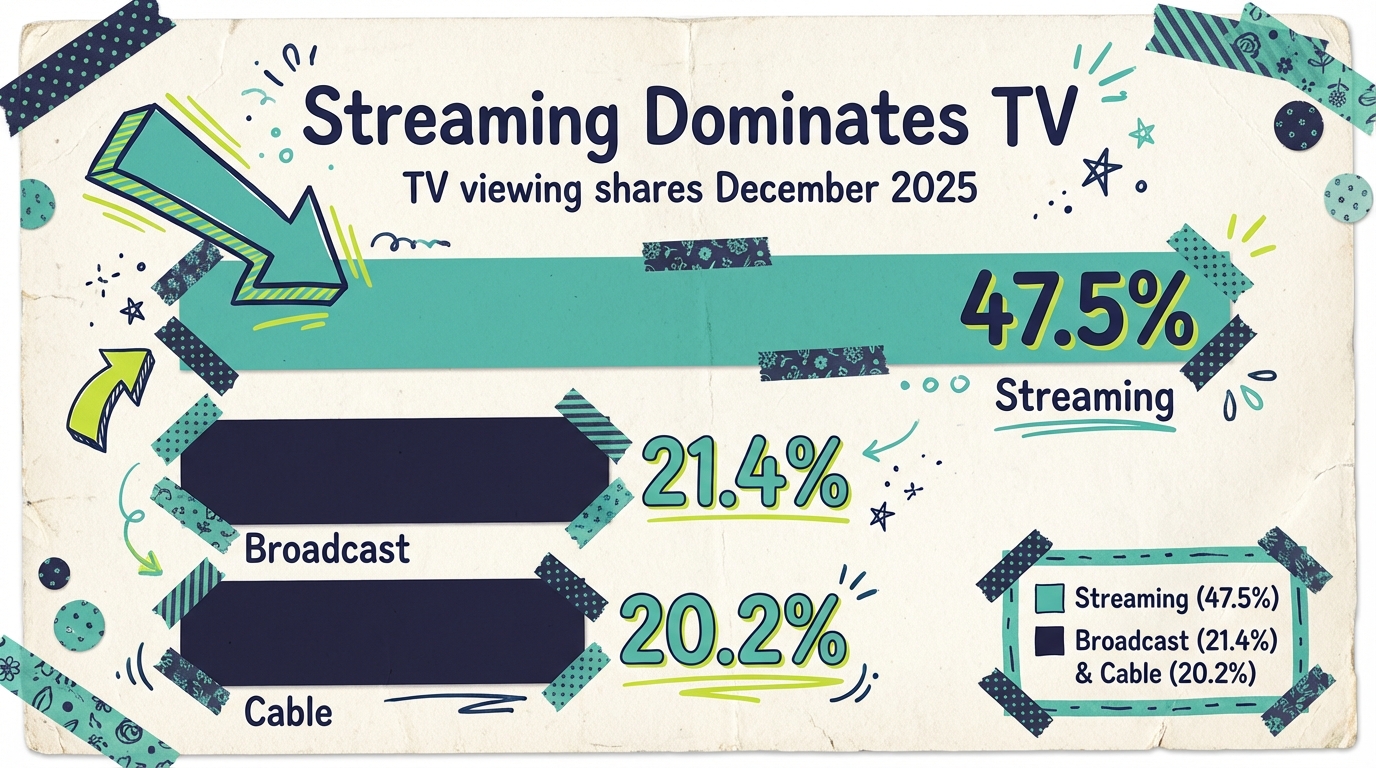
47.5%
Streaming's share of TV viewing (Dec 2025)
20.2%
Cable's shrinking TV share (Dec 2025)
December 2025 shattered streaming records and confirmed what industry observers have anticipated for years: streaming has decisively overtaken traditional television as the primary way Americans watch content on the big screen.
According to Nielsen's December 2025 Gauge report, streaming captured 47.5% of all U.S. television viewing in December, beating the previous record of 47.3% set in July 2025. This represents the largest share of TV ever reported in Nielsen's measurement history. Cable, meanwhile, accounted for just 20.2% of viewing, and broadcast held 21.4%.
The dominance was particularly striking on Christmas Day 2025, when streaming surged to 55.1 billion viewing minutes, shattering the previous single-day record by 8%. Streaming represented 54% of all TV usage that day, the largest single-day share ever recorded. It wasn't a fluke: December 13, 2025 also saw streaming exceed 50% of daily TV usage for the first time, hitting 50.4%.
The trajectory over the past year tells the story clearly. In May 2025, streaming's 44.8% share exceeded the combined total of broadcast and cable for the first time. By December, streaming had added nearly three more percentage points while cable lost roughly four. The gap between streaming and traditional TV isn't narrowing. It's accelerating.
YouTube leads all streaming platforms with a commanding 12.7% share of total TV viewing in December 2025. Netflix grew 10% month-over-month to hit a record 9% share, driven largely by the return of "Stranger Things." Disney's combined properties (Disney+, Hulu, and ESPN+) captured 4.7% of viewing, while Amazon Prime Video surged 12% to a record 4.3%. Even the Roku Channel hit an all-time high at 3% of TV.
For advertisers, the platform breakdown matters enormously. YouTube and many of these growing streamers are primarily ad-supported, meaning their audience growth represents expanding advertising inventory. The 77+ million households that have cut the cord haven't disappeared. They've moved to platforms where connected TV advertising can reach them more efficiently than traditional cable ever could.

---
The headline statistics only tell part of the story. Understanding who is cutting the cord, why they're doing it, and where they're watching provides crucial context for any advertising strategy.
The raw household counts paint a dramatic picture of the shift:
80.7 million non-pay-TV households projected by end of 2026 according to eMarketer
77.2 million cord-cutting households in 2025, up from 37.3 million in 2018
54.3 million pay TV households expected by 2026, down from 90.3 million at cable's peak
42.4% pay TV penetration expected in 2026, compared to roughly 88% in 2010
The crossover point has already passed. Non-pay-TV households now outnumber traditional cable subscribers, and the gap widens every quarter. According to Marketing Charts analysis of eMarketer data, fewer than half of U.S. households will have traditional pay TV by 2026.
The major cable providers continue hemorrhaging customers. Cord Cutters News reported that Comcast and Charter (Spectrum) collectively lost over 1.3 million pay-TV customers in the first three quarters of 2025 alone.
Comcast's Q4 2025 earnings, reported on January 29, 2026, revealed the company lost 245,000 additional pay TV customers during the fourth quarter, bringing its total to 11.27 million TV subscribers. For the full year 2025, Comcast shed 1.15 million TV subscribers. The company is now losing roughly 3,500 TV customers every single day.
The losses aren't limited to traditional cable. The entire pay TV ecosystem, including satellite providers, continues to contract. Virtual MVPDs (streaming live TV services like YouTube TV and Hulu + Live TV) have grown, but not nearly enough to offset the decline. According to eMarketer, the combined percentage of households with either traditional pay TV or a vMVPD will drop from 63.2% in 2022 to 54.8% by 2026.
Cord-cutting isn't uniform across demographics. According to Cable Compare's analysis of industry data:
50% of Americans under 32 won't pay for cable, per Adweek research
Millennials and Gen Z are the primary cord-cutting demographics
Urban households have higher cord-cutting rates than rural areas (better broadband access)
Higher-income households are increasingly cutting the cord by choice, not necessity
The "cord-never" phenomenon deserves special attention. These are younger consumers who have never subscribed to traditional pay TV in their adult lives. They grew up with Netflix, YouTube, and streaming as their default. For advertisers, this represents a generation that's fundamentally unreachable through traditional TV advertising channels.
Cost remains the overwhelming driver of cord-cutting decisions. According to industry surveys, 86.7% of cord-cutters cite high prices as a significant reason for switching to streaming. With average cable bills exceeding $100 per month (and often including dozens of unwanted channels), the economics favor streaming for most households.
Other key motivations include:
Flexibility: No long-term contracts with most streaming services
On-demand access: Watch what you want, when you want
Content availability: Premium content increasingly streaming-first
Multi-device viewing: Watch on any screen, anywhere
Bundle fatigue: Resistance to paying for unwanted channels
Cord Cutters News research found that cord-cutters continue saving money compared to cable subscribers, even as streaming prices rise. The average cord-cutter can subscribe to 3-4 streaming services and still pay less than a typical cable bill.

---
The cord-cutting revolution has direct, practical implications for how businesses allocate advertising budgets and reach their target customers. If you're still relying primarily on traditional TV advertising, you're missing a growing share of your potential audience.
Every quarter, your potential reach through traditional cable advertising shrinks. The math is simple: if Comcast and Charter are losing over 3,500 TV customers daily combined, that's over 100,000 potential viewers exiting the traditional TV ecosystem every month. Same ad spend, fewer impressions, older audience.
Cable viewers now skew increasingly older. Younger demographics have either cut the cord or never subscribed at all. If your target customer is under 50, relying solely on cable TV advertising means missing a substantial and growing portion of your addressable market. The problem compounds each year as cord-cutting continues accelerating.
Here's the good news: cord-cutters haven't stopped watching TV. They've moved to streaming. December 2025's 47.5% streaming share represents massive, growing audience that's now accessible to advertisers of all sizes.
Streaming actually improves advertising efficiency for many businesses compared to traditional cable:
Same premium screen: Content still consumed on the biggest screen in the house
Engaged viewing: Streaming viewers actively choose content, leading to higher engagement
Precise targeting: Target by geography, demographics, interests, and behavior
Better measurement: Track impressions, completion rates, and conversions
Lower minimums: Platforms like Adwave offer campaigns starting at $50
The December 2025 data shows ad-supported streaming growing rapidly. Netflix, Disney+, and other premium services now offer ad-supported tiers, and viewers are choosing them to save money. According to Nielsen's Q3 2025 Ad-Supported Gauge, ad-supported viewing continues growing as a share of total TV time.
For local businesses, cord-cutting initially seemed problematic because streaming often meant national reach. That's changed dramatically. Modern streaming TV advertising offers geographic targeting as precise as traditional local cable, often more so:
ZIP code and DMA targeting: Reach only viewers in your service area
Radius targeting: Target within 15, 25, or 50 miles of your location
Household-level precision: Streaming platforms can target individual households
Programmatic efficiency: Only pay for impressions in your market
Platforms like Adwave enable local TV advertising across 100+ streaming channels, ensuring your budget reaches potential customers in your specific market rather than paying for national reach you don't need.

---
Understanding the cord-cutting data is useful. Knowing how to act on it is what actually grows your business.
The smartest approach for most small businesses is to begin with a test campaign that proves the concept before scaling. Set aside $100-$300 for an initial two-week test. You're not trying to achieve massive reach with this budget. You're learning what resonates with your audience and building data for optimization. Platforms like Adwave make it easy to launch with minimal budgets while accessing premium streaming inventory across Hulu, Peacock, Tubi, and dozens of other services.
Use streaming's targeting capabilities to reach cord-cutters specifically:
Geographic targeting: Start with a 15-25 mile radius around your location for local businesses
Demographic targeting: If your customers skew younger (under 50), streaming is where they are
Dayparting: Evening hours (7-10 PM) capture the most engaged streaming viewers
Platform selection: Different platforms attract different audiences. FAST channels like Tubi and Pluto TV reach cost-conscious cord-cutters
If you're currently running cable advertising, consider reallocating a portion of that budget to streaming. The audiences complement each other, and the data from streaming campaigns will inform your overall strategy.
Your ads need to work in the streaming environment:
15-30 second spots: Standard lengths for most streaming platforms
Strong opening: Capture attention in the first 3 seconds
Clear branding: Ensure your brand is visible throughout
Appropriate CTA: Tell viewers what action to take next
Quality production: Match the premium content environment
Don't have video production capabilities? AI-generated TV commercials can create professional spots from your existing website and assets in minutes.
Streaming advertising offers measurement capabilities traditional TV never could:
Impressions and reach: How many people saw your ads
Video completion rate: Engagement quality indicator
Website visits: Traffic correlated with campaigns
Brand search lift: Are more people Googling your business?
Store visits: For physical locations, foot traffic changes
QR code scans: Direct response tracking if included in creative
Track these metrics consistently and optimize based on what you learn. Most streaming platforms provide real-time dashboards showing campaign performance.
---
Cord-cutting is part of a broader transformation in media consumption that extends far beyond the living room TV.
The cord-cutting trend isn't slowing. If anything, December 2025's record numbers suggest acceleration. Each cable rate increase pushes more subscribers toward streaming. Each generation that enters adulthood is less likely to ever subscribe to traditional pay TV. Each improvement in streaming content and technology makes the switch easier.
Industry analysts project streaming will capture over 50% of all TV viewing on a sustained basis within 2026. Nielsen's December data already showed streaming exceeding 50% on two separate days in December 2025, suggesting the monthly average will follow.
Traditional cable won't disappear entirely, but its role continues shrinking. Live sports remain cable's strongest anchor, though streaming sports options are expanding rapidly with services like ESPN+, Peacock, Amazon Prime Video, and Apple TV+ securing major rights. Cable news networks retain dedicated audiences, particularly during major events. Older demographics (65+) remain more cable-loyal, though even this group is gradually shifting to streaming.
For advertisers, the implication is clear: traditional TV advertising increasingly reaches a smaller, older audience at a higher effective cost. The premium for reaching younger, more diverse demographics now lives in streaming.
Interestingly, streaming is absorbing many elements of traditional TV. FAST (Free Ad-Supported Streaming TV) channels like Pluto TV and Tubi recreate the lean-back, channel-surfing experience. Live sports are increasingly available on streaming platforms. Ad-supported tiers on premium services resemble traditional TV economics.
This convergence benefits advertisers. The familiar format of TV advertising, with its brand-building power and big-screen impact, remains available. But now it comes with digital targeting, measurement, and accessibility that traditional TV never offered.
Several implications emerge from the cord-cutting trajectory:
Streaming literacy is essential: Understanding CTV advertising is no longer optional
Budget shifts should accelerate: More advertising dollars should flow to streaming annually
Targeting improves continuously: Streaming measurement and targeting capabilities advance each year
Creative flexibility increases: Digital delivery enables more creative testing and personalization
Small business access expands: The democratization of TV advertising continues
---
Industry analysts and media observers have extensively documented the cord-cutting acceleration and its implications for advertisers.
Nielsen's December 2025 Gauge report noted that streaming's 47.5% share represented "the largest share of TV ever reported in The Gauge." The measurement firm emphasized that the shift isn't cyclical or temporary but represents a fundamental restructuring of television consumption.
The Wrap's analysis of December viewing data highlighted Christmas Day's 55.1 billion streaming minutes as evidence that "streaming has become the default choice for American households during peak viewing moments."
eMarketer's cord-cutting analysis has consistently forecast that cord-cutting "hasn't lost momentum," projecting continued acceleration through 2026 and beyond. The research firm notes that rising streaming prices have not meaningfully slowed cord-cutting, as consumers still save money compared to cable bundles.
Marketing experts increasingly recommend treating streaming as the primary TV advertising channel rather than a supplement to traditional TV. The strategic priority has inverted from where it stood just five years ago, when streaming was considered experimental for most advertisers.
---
Over 77 million American households have either cut the cord (canceled cable) or are cord-nevers (never subscribed). This number is projected to reach 80.7 million by the end of 2026, according to eMarketer forecasts. Non-pay-TV households now outnumber traditional cable subscribers, and the gap widens each quarter as major providers like Comcast and Charter continue losing hundreds of thousands of customers monthly.
Yes. December 2025's record 47.5% streaming share demonstrates continued acceleration. Comcast lost 1.15 million TV subscribers in 2025 alone, continuing the multi-year trend. Each cable rate increase and each new streaming option further incentivizes cord-cutting. Industry analysts project streaming will sustain over 50% of TV viewing by late 2026.
Cost remains the primary driver, with 86.7% of cord-cutters citing high cable prices as a significant reason for switching. Average cable bills exceed $100 monthly, often including dozens of unwanted channels. Cord-cutters typically can subscribe to multiple streaming services for less than a cable bill while getting more content they actually want, plus the flexibility of no long-term contracts.
Absolutely. Cord-cutters haven't stopped watching TV content; they've shifted to streaming. Connected TV advertising reaches these audiences across services like Hulu, Peacock, Tubi, and 100+ other platforms. Modern streaming advertising actually offers advantages over traditional cable, including precise geographic targeting, better measurement, and lower minimum budgets. Platforms like Adwave make streaming TV advertising accessible starting at $50.
Cord-cutting initially seemed problematic for local advertisers because streaming often meant national reach. That's changed. Modern CTV platforms offer geographic targeting by ZIP code, DMA, or radius, allowing local businesses to reach only viewers in their service area. Local streaming TV advertising can be more efficient than traditional cable because you're not paying for wasted reach outside your market.
Traditional cable will continue declining but probably won't disappear entirely in the near term. Live sports, older demographics, and areas with limited broadband will sustain some cable viewership. However, the trajectory is clearly toward streaming dominance. By 2026, pay TV penetration is expected to drop to around 42% of households, compared to 88% at cable's peak.
---
The cord-cutting trend isn't a challenge; it's an opportunity. Streaming advertising allows businesses of all sizes to reach TV audiences with precision and efficiency that traditional cable never offered.
Adwave makes streaming TV advertising accessible for small businesses. Create a professional TV commercial in minutes using AI, then launch it across Hulu, Peacock, Tubi, and 100+ premium streaming channels starting at just $50. No video production experience required. No massive budgets. No agencies.
See how it works | View pricing | Create your first ad
---