Ready in minutes
AI builds your ad from a single prompt


September 04, 2025
CTV ad spend is growing 16% year-over-year, outpacing all other advertising channels.
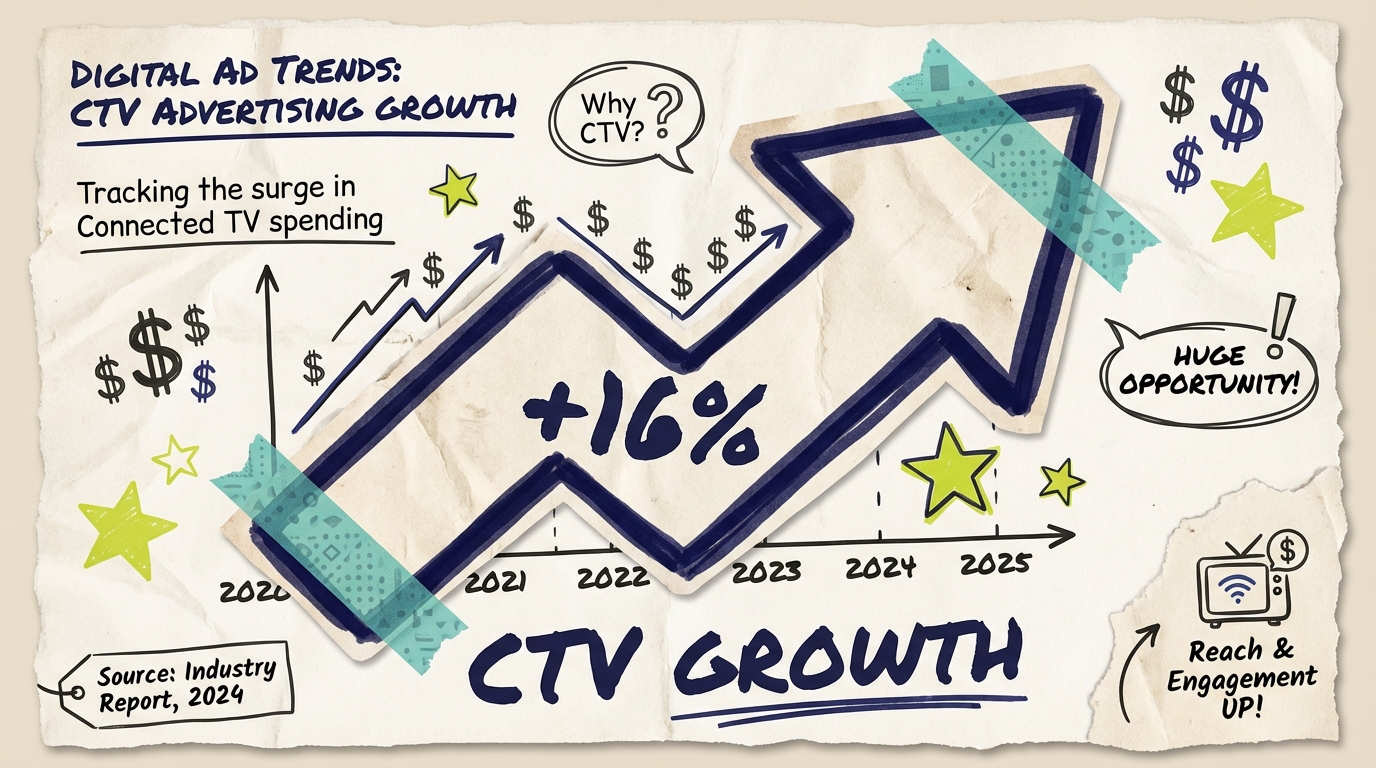
+16%
CTV ad spend year-over-year growth in 2024
$33B
Projected CTV ad spend in 2025
60%
Digital video share of total TV/video ad spend
Connected TV advertising grew 16% year-over-year in 2024, according to the IAB's annual report. This marks a return to double-digit growth after a temporary slowdown in 2023 when broader advertising market conditions caused a brief pause. With CTV advertising spending projected to reach $33 billion in 2025, connected TV remains the fastest-growing segment of television advertising. It continues outpacing both traditional TV and most other digital advertising channels.
The 16% growth rate represents a significant acceleration in the streaming advertising market. This growth is driven by multiple converging factors. Consumer migration from traditional TV to streaming continues. Major streaming services have launched and expanded ad-supported tiers. Advertisers have increasing confidence in CTV measurement and attribution capabilities. For businesses considering TV advertising, understanding this growth trajectory helps inform strategic decisions about where to allocate advertising budgets.
Multiple research firms track CTV advertising growth with consistent findings about the channel's expansion.
The IAB's research reveals the trajectory of CTV advertising spending. CTV ad spend grew +16% year-over-year in 2024. Approximate CTV ad spend in 2024 was $28 billion. Projected CTV ad spend in 2025 is $33 billion. Expected growth rate from 2024 to 2025 is +18%. CTV has returned to double-digit growth after 2023 normalization.
This growth rate significantly outpaces traditional TV advertising, which has been declining in the low single digits annually. It also exceeds overall digital advertising growth rates.
CTV advertising growth has varied year to year but maintained a strong upward trajectory.
From 2019-2021, the hypergrowth period delivered 30-40%+ annual increases. In 2022, growth moderated but remained strong at approximately 20%. In 2023, a temporary slowdown to single digits occurred amid broader ad market softness. In 2024, the market returned to 16% growth as conditions improved. From 2025 onward, continued double-digit growth is expected.
The 2023 slowdown reflected general advertising market headwinds rather than CTV-specific concerns. The rebound in 2024 demonstrates underlying advertiser demand for streaming advertising.
CTV's share of the overall TV advertising market continues expanding.
Digital video now represents 60% of total TV/video ad spend. CTV takes share from traditional TV each year. Premium CPMs are approaching or matching traditional TV in many cases. Investment is following attention as advertiser dollars track viewer migration.
The shift in spending mirrors the shift in viewing. As audiences move from cable and broadcast to streaming, advertising budgets follow.
CTV's growth rate stands out compared to other advertising channels.
Traditional TV is declining 3-5% annually. Social media is growing 5-10% annually. Search advertising is growing 8-12% annually. CTV is growing 15-20% annually.
CTV's outperformance reflects its unique combination of big-screen engagement and digital targeting capabilities.

Understanding what's driving CTV advertising growth reveals opportunities for advertisers.

Several factors contribute to CTV's exceptional growth.
Viewer migration drives spending. Streaming now accounts for over 45% of total TV viewing, with the share growing each month. Advertisers follow audiences, and audiences are streaming.
Ad-supported expansion creates inventory. The launch and expansion of ad-supported tiers from Netflix, Disney+, Amazon Prime Video, and Max have dramatically increased premium streaming advertising inventory. More inventory with premium content attracts more advertiser spending.
Measurement has matured. CTV measurement has improved significantly, giving advertisers confidence that they can track results. Better measurement reduces risk and encourages budget allocation.
Self-serve platforms expand access. The emergence of self-serve CTV platforms has made streaming advertising accessible to small and medium businesses previously unable to access TV advertising. More advertisers means more total spending.
Creative tools lower barriers. AI-powered creative tools have reduced the production barrier for TV commercials, enabling more businesses to advertise on television.
Major streaming services adding ad-supported options has accelerated CTV growth.
Netflix launched its ad tier in November 2022 and rapidly grew to millions of ad-supported subscribers. This provides premium content in an ad-supported environment.
Disney+ added its ad tier in December 2022, providing access to Disney's content library for advertisers.
Amazon Prime Video made advertising the default in January 2024, instantly creating one of the largest ad-supported streaming audiences.
Max (HBO) offers an ad-supported tier providing access to HBO and Warner Bros. content.
Each launch added significant premium inventory to the CTV market, driving spending growth.
As traditional TV viewing and advertising decline, budgets shift to CTV.
Cable and satellite subscriptions continue declining through cord-cutting. Broadcast TV viewing represents only about 20% of total TV time. Traditional TV advertising budgets are being reallocated to streaming. Advertisers increasingly see CTV as the future of TV advertising.
This reallocation represents both CTV growth and traditional TV decline. Net TV advertising is relatively stable but composition is changing dramatically.

CTV advertising's growth trajectory has practical implications for businesses considering streaming advertising.
As CTV advertising grows, more inventory becomes available.
More streaming services offer advertising options. More content is available in ad-supported formats. More time slots become available for advertisers. Lower barriers to entry exist for small businesses.
Increased inventory benefits advertisers through improved access and competitive pricing.
The 16% growth rate reflects increased advertiser confidence in CTV.
Measurement works and advertisers are satisfied with attribution capabilities. Results are being delivered and CTV campaigns are meeting performance expectations. Brand safety concerns have been addressed. Pricing is acceptable relative to value delivered.
This confidence, demonstrated through spending, suggests CTV advertising delivers results worth the investment.
CTV growth aligns with audience behavior.
Viewers are watching streaming, not cable. Advertisers following viewers to streaming are seeing results. Businesses not advertising on streaming miss growing audiences. The shift is permanent, not temporary.
For businesses currently advertising only on traditional TV or not on television at all, CTV growth suggests it's time to test streaming.
As more businesses advertise on CTV, competitive dynamics emerge.
Early movers may have advantages in developing expertise. Growing competition may affect CPMs over time. Understanding CTV becomes a marketing competency. Businesses not present cede streaming audiences to competitors.
The growth rate indicates CTV advertising is becoming standard practice, not an experimental channel.

Capitalizing on CTV growth requires practical steps to launch and optimize streaming advertising.

Given CTV's growth trajectory, testing sooner provides advantages.
Learn while costs are reasonable. CPMs may increase as demand grows.
Develop expertise. Understanding what works takes experimentation.
Establish presence. Begin building streaming audience relationships.
Iterate. Multiple campaigns provide optimization opportunities.
Platforms like Adwave enable testing with budgets starting at $50, making CTV experimentation accessible.
As advertising budgets are allocated, consider CTV's trajectory.
If already advertising on TV, shift some traditional TV budget to CTV testing. If only advertising digital, add CTV as a brand-building complement. If not advertising, CTV may be an accessible starting point for TV. Plan for growth and budget for CTV testing and scaling.
The 16% industry growth rate suggests many businesses are increasing CTV allocation. Match or exceed the industry pace to remain competitive.
The growth of self-serve CTV platforms makes streaming advertising accessible.
Aggregated inventory through platforms like Adwave combines 100+ channels. Low minimums let you start with $50-$200 for initial testing. AI creative tools generate commercials without production budgets. Simple targeting offers geographic and demographic targeting without complexity.
These platforms democratize access to the same streaming inventory previously reserved for large advertisers.
Take advantage of CTV's measurement capabilities.
Track reach and frequency to understand audience exposure. Monitor completion rates to ensure ads are being watched. Attribute conversions to connect ad exposure to outcomes. Test creative to experiment with different messages and formats. Optimize targeting to refine geographic and demographic targeting.
Digital measurement capabilities differentiate CTV from traditional TV advertising.
CTV advertising growth is part of broader transformations in media and advertising.
CTV advertising growth parallels the streaming viewership transformation.
Over 45% of TV viewing is now streaming. The majority of households have streaming access. Younger generations are streaming-native. The shift is permanent and accelerating.
Advertising follows attention. As attention shifts to streaming, advertising follows.
CTV growth raises questions about traditional TV advertising's trajectory.
Linear TV will remain but with diminished scale. Live sports may sustain some traditional TV value. Older demographics still watch traditional TV. But the trend is clear: streaming is the future of TV.
Businesses should prepare for a streaming-dominant advertising landscape while still reaching traditional TV audiences where valuable.
The CTV advertising ecosystem continues attracting investment.
Measurement companies are improving attribution. Creative tools are reducing production barriers. Self-serve platforms are expanding access. Data solutions are improving targeting.
This investment improves the CTV advertising experience for all advertisers, including small businesses.
Industry analysts have noted CTV's continued momentum.
The IAB reports that "CTV rebounds to double-digit growth in 2024," indicating renewed confidence after 2023's moderation. Digital video now commands 60% of total TV/video advertising spend, reflecting the industry's recognition of streaming's importance.
eMarketer and other research firms project continued double-digit growth through 2025 and beyond, with CTV spending potentially reaching $40+ billion within a few years.


CTV advertising grew 16% year-over-year in 2024 according to IAB data. This marks a return to double-digit growth after a temporary slowdown in 2023. Spending is projected to reach $33 billion in 2025, with continued double-digit growth expected through the decade.
CTV benefits from multiple tailwinds. Viewer migration from traditional TV to streaming continues. Ad-supported tiers from major platforms have expanded. Measurement capabilities have improved. Accessible self-serve platforms enable small business participation. Traditional TV is declining while streaming viewing grows, creating natural budget reallocation.
Digital video (including CTV) now represents approximately 60% of total TV and video advertising spend according to IAB data. CTV continues taking share from traditional TV as viewership patterns shift to streaming platforms.
Current projections suggest continued double-digit growth for CTV advertising through at least 2025-2027. The underlying drivers (viewer migration, ad-tier expansion, measurement improvement) remain strong. While growth rates may eventually moderate, CTV appears to have significant runway remaining.
CTV growth has kept CPMs relatively stable despite increasing demand. More inventory from ad-tier launches and content expansion has offset demand growth. Current CTV CPMs range from $15-35, with an average around $25 for small business advertisers.
Additional statistics that contextualize CTV advertising growth:
CTV year-over-year ad spend growth in 2024 was +16%. Approximate CTV ad spend in 2024 was $28 billion. Projected CTV ad spend in 2025 is $33 billion. Expected CTV growth rate from 2024-2025 is +18%. Digital video share of total TV/video ad spend is 60%. Streaming share of total TV viewing exceeds 45%. Traditional TV advertising is declining 3% to 5% annually. CTV CPM range through aggregated platforms is $15-35. Minimum budget to start CTV advertising on platforms like Adwave is $50.
Ready to be part of the fastest-growing advertising channel? CTV advertising has returned to double-digit growth, and businesses of all sizes are participating.
Adwave makes CTV accessible with AI-powered creative generation and campaigns starting at just $50. Your ads run on 100+ premium streaming channels including YouTube, Netflix, Hulu, Peacock, and more.
No video production experience required. No massive budgets. No complex media buying.