Ready in minutes
AI builds your ad from a single prompt


January 26, 2026
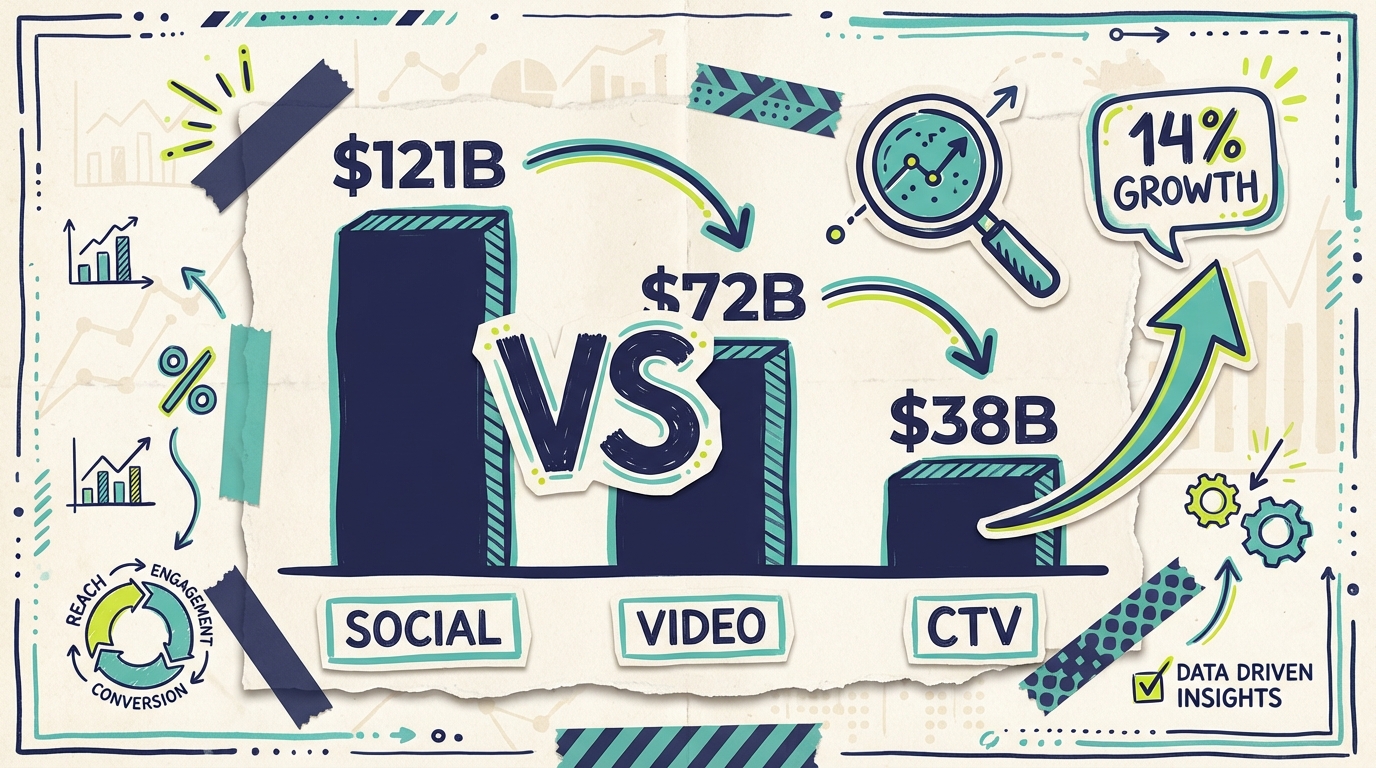
The advertising landscape reveals three distinct but overlapping video categories, each with different scale, growth rates, and value propositions for advertisers.
CTV ad spending in the U.S. reached $33.35 billion in 2025 and is projected to grow to approximately $38 billion in 2026, representing roughly 14% year-over-year growth, according to eMarketer and MNTN Research. By 2028, CTV spending is expected to hit $46.89 billion, and by 2029, approximately $51 billion. This makes CTV the fastest-growing major advertising channel in the United States.
Social media advertising in the U.S. is projected to reach $121 billion in 2026, according to eMarketer's social network ad spending forecast. That's more than three times larger than CTV. However, social media's growth has moderated significantly, with single-digit year-over-year increases now the norm after years of double-digit expansion. The channel has reached maturity, with growth rates that more closely resemble the broader advertising market.
Online video advertising presents the most complex comparison because it encompasses multiple subcategories. Total U.S. digital video ad spending is projected to reach $72 billion in 2025, according to IAB research, growing at approximately 18% year-over-year. This category includes CTV, YouTube, social video (TikTok, Instagram Reels, Facebook video), in-stream ads, and outstream formats. CTV represents roughly 46% of that digital video total when measured by spend.
YouTube alone represents a significant piece of the video advertising puzzle. Google and YouTube combined will generate approximately $229 billion in global digital ad revenues in 2026, placing them essentially tied with Facebook and Instagram globally. YouTube's CTV-specific ad revenues are expected to reach approximately $9.21 billion in 2026, representing nearly 12% of the total CTV market.
The growth trajectories tell a crucial story. CTV is growing at 14-16% annually, while social media advertising grows in single digits. Digital video overall grows at 18%, driven primarily by CTV's expansion and continued social video growth. For advertisers, these rates suggest where budget allocations will shift in coming years. Money follows growth, and CTV's trajectory attracts increasing advertiser interest.
Market share within digital video is evolving rapidly. According to industry analysis, CTV is on pace to exceed 40% of global ad spending by 2030. Linear TV has already fallen to just 12% of global ad spending. The crossover point where CTV surpasses traditional TV is expected by 2028. Within a decade, streaming TV will dominate the video advertising landscape that broadcast and cable television controlled for 70 years.

---
Understanding how these channels compare requires examining multiple dimensions beyond raw spending totals.
Social media offers the broadest reach among digital channels. Facebook alone reaches over 3 billion monthly active users globally. Instagram has achieved 3 billion monthly users. TikTok reaches over 1 billion. For sheer audience size, social platforms dwarf every other digital channel.
CTV reaches a smaller but highly valuable audience. Approximately 90% of U.S. households now have at least one connected TV device, according to industry estimates. Nielsen data shows that streaming captured 47.3% of all U.S. TV viewing in mid-2025. When viewers are on CTV, they're engaged in lean-back viewing with full attention on content, not scrolling through feeds.
Online video reaches audiences across both environments. YouTube alone reaches more U.S. adults than any cable network. Social video formats like TikTok and Reels capture significant mobile attention. The combination means video advertising can reach audiences across contexts and devices.
The engagement comparison strongly favors CTV despite its smaller scale. CTV video completion rates exceed 95%, meaning viewers watch ads to the end. Social media video completion rates vary dramatically by format and platform, often ranging from 15% to 50%.
Attention metrics tell a similar story. CTV delivers what researchers call "lean-back attention," where viewers are relaxed, engaged with content, and watching on larger screens. Social media delivers "lean-forward attention," where users actively scroll and can easily skip past content. Studies consistently show higher ad recall and brand lift from TV advertising compared to social.
The premium environment of streaming also matters. CTV ads appear alongside professional content that viewers chose to watch. Social ads appear in feeds alongside user-generated content, news, and countless other distractions. The contextual quality differs substantially.
Social media has historically offered the lowest barriers to entry. A small business can launch Facebook or Instagram ads with $5 and a credit card. The self-serve interfaces require no special relationships or minimum commitments. This accessibility drove social media's rapid adoption among small advertisers.
CTV accessibility has improved dramatically but still requires more sophisticated entry. Platforms like Adwave now enable CTV advertising starting at $50, with AI-generated creative that eliminates production costs. However, premium inventory on major platforms like Netflix or Hulu direct may still require minimum buys of $5,000 or more.
Online video falls in between. YouTube advertising is as accessible as other Google Ads products. Social video platforms offer easy entry. But traditional online video advertising through publishers and networks often required agency relationships and substantial minimums until programmatic buying democratized access.
Social media offers the most direct attribution. Click-through tracking, pixel-based conversion tracking, and closed-loop measurement connect ad exposure to immediate actions. Advertisers can see exactly which ad drove which purchase.
CTV measurement is improving rapidly but remains less direct. View-through attribution tracks whether someone who saw an ad later visited a website or made a purchase. Brand lift studies measure awareness and consideration changes. QR codes in creative provide direct response mechanisms. But the leap from TV screen to conversion action isn't as seamless as a click.
Online video measurement varies by format. YouTube offers robust measurement through Google's ecosystem. Social video provides platform-specific metrics. Traditional online video relies on viewability standards and brand safety verification.
CPM comparisons require context because the metrics measure different experiences.
CTV CPMs typically range from $25 to $35 through aggregated platforms, with premium inventory commanding $40 to $65 or more. These rates reflect full-screen, non-skippable, sound-on advertising in a premium environment.
Social media CPMs vary dramatically by platform, targeting, and format. Facebook feed ads might run $7 to $12 CPM. Instagram Stories could be $8 to $15. TikTok varies widely. However, these lower CPMs reflect shorter, skippable ads with divided attention.
Online video CPMs fall across a wide range. YouTube TrueView (skippable) might be $10 to $20. Non-skippable YouTube commands higher rates. Social video falls between feed and traditional video pricing.
Direct CPM comparison is misleading because viewer engagement differs so substantially. A $30 CTV CPM delivering 95% completion and brand recall may provide better value than a $10 social CPM with 20% completion.

---
The size comparison between CTV, social, and online video matters less than understanding which channel serves your specific objectives.
Social media excels at performance marketing with direct, trackable outcomes. If your goal is immediate website visits, lead form completions, or e-commerce purchases, social platforms offer sophisticated targeting and optimization for those actions. The ability to drive clicks and conversions in-session makes social the default choice for direct response campaigns.
CTV excels at brand building, awareness, and trust. Television remains the most trusted advertising medium among consumers. The premium viewing environment, full-screen format, and lean-back attention create impressions that register more deeply than scrollable content. If your goal is establishing brand presence, building recognition in your market, or differentiating from competitors, CTV delivers impact that social cannot match.
The combination proves most powerful. Research consistently shows that pairing streaming TV with social advertising boosts brand recall by 5x compared to social alone. CTV builds awareness and credibility, while social captures demand and drives conversion. Using both channels creates a funnel that neither can achieve independently.
For local businesses, the calculus has shifted significantly. Traditional thinking held that small businesses should focus exclusively on social and search because TV was too expensive and broad. Streaming TV advertising has changed that equation. A restaurant, dental practice, or home services business can now run TV advertising with geographic targeting, reaching only households in their service area, at budgets starting from $50.
The trust factor deserves emphasis for local businesses. When potential customers see your business on TV, specifically streaming TV alongside major networks and premium content, you gain implicit credibility. That's true whether you're on Hulu, Peacock, or dozens of other streaming services. Social media presence is expected and unremarkable. Television presence signals legitimacy in ways that affect consumer perception.
Budget allocation should reflect objectives, not just channel size. If social media represents $121 billion in spending and CTV represents $38 billion, that doesn't mean social deserves 3x your budget. It means different advertisers prioritize different outcomes. Small businesses often over-index on social because it's familiar and measurable, while under-investing in brand building that CTV uniquely provides.

---
Understanding the relative sizes of CTV, social, and online video advertising helps inform strategy. Acting on that understanding requires a practical approach.
Start by clarifying your objectives. Are you primarily seeking immediate, measurable conversions (leads, purchases, appointments)? Social media's performance capabilities likely deserve the majority of your budget. Are you building brand awareness, establishing market presence, or differentiating from competitors? CTV's trust and recall advantages make it essential. Most businesses need both, and the question becomes ratio allocation.
For businesses currently relying exclusively on social media, consider adding CTV as a complementary channel. A test budget of $200 to $500 over two to four weeks provides enough data to evaluate impact. Target your service area geographically, using a 15 to 25 mile radius for local businesses. Run during evening hours when households are watching. Measure brand search volume, direct traffic, and customer acquisition source surveys to gauge impact.
For businesses already using CTV, ensure you're not neglecting the performance layer. Social media's ability to capture demand that TV creates is valuable. Retargeting viewers who've seen your TV ads with social follow-up can improve overall campaign efficiency. The channels work together more effectively than either works alone.
Creative considerations differ by channel. CTV requires 15 or 30 second video spots designed for full-screen, sound-on viewing. Platforms like Adwave generate these from your website using AI, eliminating production barriers. Social video can be shorter, more casual, and formatted for vertical mobile viewing. The same message may need different expressions for each environment.
Measurement approaches should reflect each channel's strengths. For social, track click-through rates, cost per acquisition, and return on ad spend. For CTV, track brand search lift, direct traffic changes, video completion rates, and customer source surveys. Attempting to measure CTV with social's metrics will undervalue its contribution, just as measuring social purely on awareness would miss its conversion strength.
Scale based on results, not assumptions. Some businesses will find CTV delivers exceptional results and deserves increased allocation. Others will find social performance marketing more directly serves their needs. The data from actual campaigns should drive budget decisions, not general assumptions about channel size or industry benchmarks.
---
The relative sizes of CTV, social, and online video advertising reflect where the digital advertising market is in its evolution, and where it's heading.
Historically, video advertising existed in silos. Television was one world, with its own buying practices, metrics, and creative standards. Online video was another, dominated by YouTube and later social platforms. Mobile video added another layer. These worlds are converging.
Today, a single video campaign can run across YouTube (on both mobile and CTV), streaming services, social platforms, and traditional online publishers. The lines between "TV," "video," and "social" blur as audiences move fluidly between screens and platforms. Advertisers increasingly think in terms of video reach across all environments rather than channel-specific strategies.
Social media's growth has slowed partly because attention is a finite resource. The average U.S. adult spends roughly 7 hours daily consuming media. Social media captures about 2.5 hours of that time, according to industry research. Television (including streaming) captures about 4 hours. The proportions shift gradually, but total time is fixed.
CTV's growth comes partly from capturing television time that once went to cable and broadcast. It also captures some mobile video time as smart TV apps become the default for streaming. The rebalancing favors video consumption on larger screens in lean-back environments, which favors CTV advertising's value proposition.
CTV's historical challenge was measurement. Advertisers comfortable with social's click-tracking hesitated to invest in channels where outcomes were less directly attributable. That's changing rapidly.
Cross-device tracking, view-through attribution, brand lift studies, and incrementality testing now provide clearer pictures of CTV's impact. The measurement gap between social and CTV has narrowed significantly. As measurement matures, advertiser confidence in CTV grows, driving budget shifts.
Social media at $121 billion growing at 5% annually will reach approximately $155 billion by 2030. CTV at $38 billion growing at 10-12% annually will reach approximately $65-70 billion by 2030. The gap narrows, though social will likely remain larger.
More interesting is what this means for small business advertising. As CTV scales, entry points lower further. Competition among platforms drives innovation in targeting and creative tools. The benefits of CTV advertising that major brands have enjoyed for years increasingly flow to businesses of all sizes.
The trajectory is clear: video advertising is shifting toward streaming, premium environments command premiums, and the barriers that once excluded small businesses continue falling.
---
Industry analysts and researchers have noted the shifting dynamics between CTV, social, and online video advertising.
eMarketer's forecast analysis highlighted that "advertisers will spend over $121 billion advertising on US social networks in 2026 and continue to gravitate toward low-price, high-reach opportunities." The research firm noted that social's growth has moderated as the channel matures, while CTV maintains double-digit expansion.
WARC Media's Global Ad Trends report emphasized CTV's structural growth: "CTV already accounts for nearly half of viewing hours, fueling billions in ad revenues. The shift signals not just changing audiences but also a fundamental rewiring of how ads are bought, measured, and monetized."
Research from Measured, an incrementality measurement platform, found that CTV outperforms Meta and Google in ROI yet remains significantly underfunded. Analyzing 274 incrementality experiments across 60 enterprise brands, the study found CTV accounted for just 3.5% of total media budgets despite delivering superior returns. The finding suggests advertisers are underallocating to CTV relative to performance.
IAB's digital video research noted that "digital video ad spend is growing much faster than other media," with the $72 billion U.S. market expanding two to three times faster than total advertising. The organization attributed growth to CTV expansion and continued strength in social video formats.
The consensus among analysts is that while social media remains larger in absolute spend, CTV's growth trajectory and performance characteristics merit increased attention from advertisers of all sizes.
---
In the U.S., social media advertising is projected to reach $121 billion in 2026, compared to approximately $38 billion for CTV. That makes social roughly three times larger by ad spend. However, growth rates favor CTV, which is expanding at 14% annually compared to single-digit growth for social. The size gap is narrowing each year as CTV continues its rapid expansion.
Yes, significantly. CTV advertising is growing at approximately 14% year-over-year in 2026, with projections of 10-12% annual growth through the end of the decade. Social media advertising has moderated to single-digit growth as the channel matures. CTV is the fastest-growing major advertising channel in the United States, while social media's growth more closely resembles the broader advertising market.
CTV delivers substantially higher engagement metrics. Video completion rates on streaming TV exceed 95%, meaning viewers watch ads to the end. Social media video completion varies dramatically but typically ranges from 15% to 50% depending on format and platform. CTV's lean-back viewing environment with full-screen, sound-on delivery creates deeper engagement than social's scrollable feed format.
Yes. Social media advertising has always been accessible to small budgets, with campaigns starting at just a few dollars. CTV has become similarly accessible through platforms like Adwave, which enables campaigns starting at $50. A small business can run meaningful campaigns on both channels with combined budgets of $500 to $1,000 monthly. The key is understanding which objectives each channel serves.
That depends on your current results and objectives. If social media is delivering strong conversion performance, maintain or even increase that allocation. Consider adding CTV as a complementary brand-building channel rather than simply replacing social spend. If social media results have plateaued or you're struggling to differentiate from competitors, CTV's trust and recall advantages may help. Most businesses benefit from using both channels together rather than choosing between them.
YouTube straddles multiple categories. It's the largest online video platform, a major social destination, and increasingly a CTV channel as viewing shifts to television screens. YouTube's CTV-specific ad revenues are projected at $9.21 billion in 2026, representing nearly 12% of the total CTV market. YouTube offers accessible entry points similar to social platforms, with the added benefit of reaching audiences across mobile and TV screens.
---
Key statistics comparing CTV, social media, and online video advertising:
U.S. CTV ad spend 2026: Approximately $38 billion (eMarketer, 2025)
U.S. social media ad spend 2026: $121 billion (eMarketer, 2025)
U.S. digital video ad spend 2025: $72 billion (IAB, 2025)
CTV growth rate 2026: Approximately 14% YoY (eMarketer, 2025)
Social media growth rate: Single digits YoY (eMarketer, 2025)
Digital video growth rate: 18% YoY (IAB/WARC, 2025)
CTV video completion rate: 95%+ (industry benchmarks)
YouTube CTV ad revenues 2026: $9.21 billion, ~12% CTV market share (eMarketer, 2025)
CTV share of media budgets: 3.5% despite higher ROI (Measured, 2025)
CTV projected share by 2030: Over 40% of global ad spending (WARC Media, 2025)
All sources linked above. Data current as of January 2026.
---
Ready to add CTV to your marketing mix? Adwave makes streaming TV advertising accessible for small businesses, with campaigns across 100+ premium networks starting at just $50. Geographic targeting ensures you reach your market. AI creates your commercial in minutes.