Ready in minutes
AI builds your ad from a single prompt


May 20, 2025
Local TV ads cost $5-30 CPM depending on market and platform. Here's the breakdown.
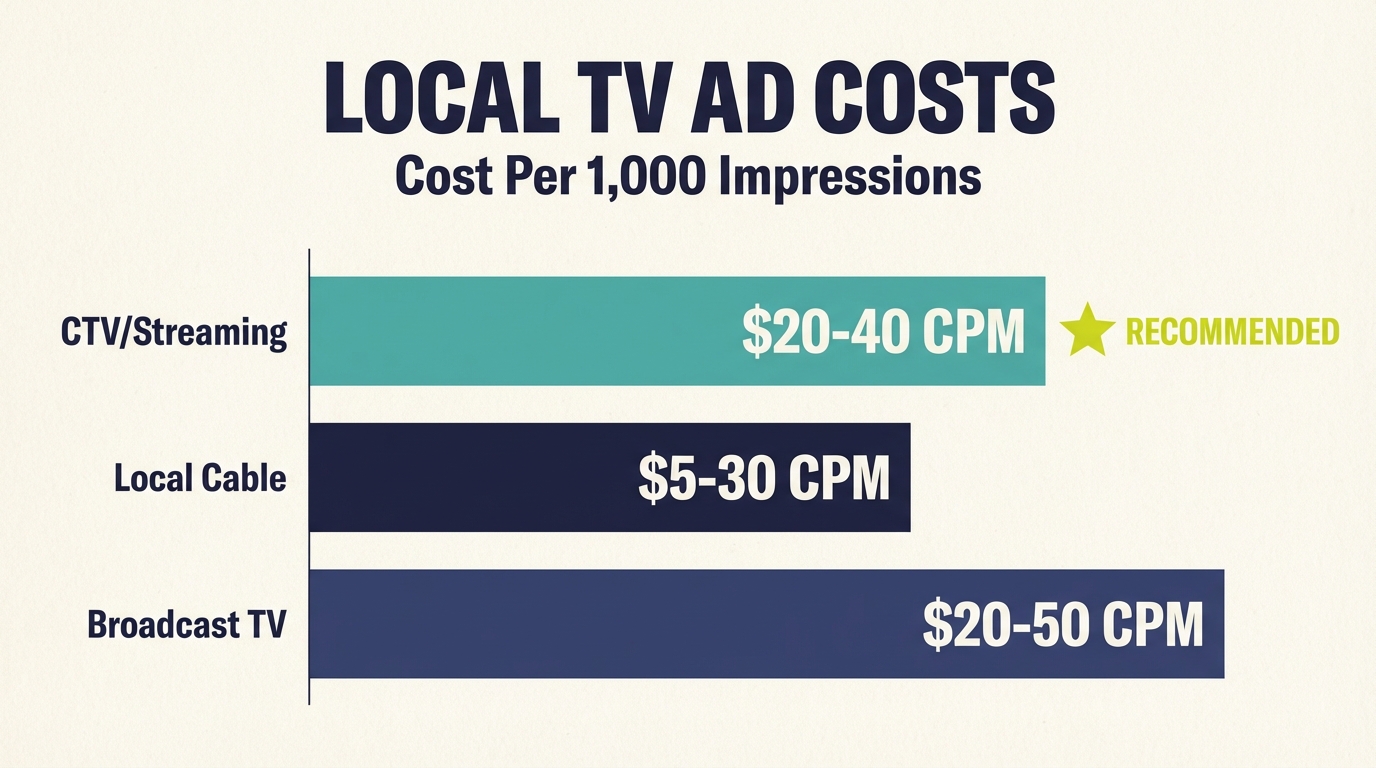
$20-40
CTV/Streaming CPM range for local targeting
$50
Minimum budget to start TV advertising with Adwave
$0
Production cost with AI-generated TV ads
A local TV ad typically costs between $200 and $5,000 per spot, depending on your market size, time slot, and whether you're advertising on cable, broadcast, or streaming platforms, according to industry research from Simulmedia. The average CPM (cost per thousand viewers) for local TV advertising ranges from $5 to $30, with most small businesses paying around $20 CPM. However, these traditional costs only tell part of the story. The rise of connected TV (CTV) and streaming platforms has fundamentally changed what's possible for local advertisers, making TV advertising accessible to businesses with budgets as low as $50.
For decades, local TV advertising was dominated by car dealerships, personal injury lawyers, and furniture stores with substantial marketing budgets. The barrier to entry was simply too high for most small businesses. Today, that landscape has shifted dramatically. Streaming TV advertising has created new pathways for local businesses to reach their communities through the most powerful advertising medium available.
Understanding the true cost of local TV advertising requires looking beyond simple rate cards to examine production costs, targeting efficiency, and the emerging alternatives that are reshaping the industry. Whether you're a restaurant owner, a real estate agent, or a home services provider, knowing what local TV advertising actually costs in 2025 helps you make smarter decisions about where to invest your marketing dollars.
Local TV advertising costs vary significantly based on market size, platform type, and time of day. Here's a comprehensive breakdown of current pricing across different advertising channels.
According to Simulmedia's 2025 TV advertising guide, local TV spot costs vary dramatically by designated market area (DMA):
Small markets (DMAs 151-210): $200 to $1,500 per 30-second spot
Mid-sized markets (DMAs 51-150): $500 to $3,000 per spot
Large markets (DMAs 1-50): $1,000 to $10,000+ per spot
Top 10 markets (NYC, LA, Chicago): $5,000 to $50,000+ per spot during prime time
These wide ranges reflect differences in inventory availability, competition for ad slots, and audience size. A prime-time spot during local news in Des Moines costs a fraction of what the same slot would cost in Los Angeles.
Different platforms offer varying cost structures for local advertisers. Based on industry data from MNTN and DanAds research:
Local broadcast TV: $15 to $30 CPM (average $20)
Local cable TV: $10 to $25 CPM (average $23)
Connected TV/streaming: $15 to $35 CPM (average $25)
YouTube on TV: $10 to $30 CPM
Hulu with local targeting: $25 to $35 CPM
The CPM model makes costs more predictable and comparable. At a $20 CPM, reaching 10,000 local viewers costs $200. At the same CPM, reaching 100,000 viewers costs $2,000. This scalability is one of CTV's major advantages for local businesses.
According to COLAB Los Angeles research, monthly budget requirements for local TV advertising typically break down as follows:
Local cable TV: $500 to $5,000 per month for meaningful presence
Local broadcast TV: $2,000 to $15,000 per month minimum
Streaming/CTV platforms: $50 to $2,000 per month (much lower entry point)
The streaming option represents a fundamental shift in accessibility. Traditional local TV required substantial monthly commitments, often with long-term contracts. CTV advertising allows businesses to start small, test, and scale based on results.
Beyond airtime, traditional TV advertising requires video production. According to Vidico's 2025 commercial cost guide:
Basic local commercial production: $1,500 to $5,000
Mid-tier production with professional talent: $5,000 to $15,000
High-quality production: $15,000 to $50,000+
AI-generated commercials (via platforms like Adwave): $0 (included with ad spend)
This production cost often exceeds the media budget for small businesses, creating a significant barrier. The emergence of AI-powered TV commercial creation has eliminated this barrier entirely for many advertisers.


Understanding local TV advertising costs requires examining the factors that influence pricing and the total investment needed for an effective campaign.
Local TV advertising rates follow predictable patterns based on when your ad runs:
Prime time (8 PM - 11 PM)
Highest viewership, highest cost
2x to 4x daytime rates
Best for broad consumer reach
Competition for limited inventory
Early fringe (4 PM - 8 PM)
Strong viewership, moderate cost
1.5x to 2x daytime rates
Good balance of reach and efficiency
Local news adjacency valuable
Daytime (9 AM - 4 PM)
Lower viewership, lowest cost
Base rate pricing
Reaches stay-at-home audiences
Good for specific demographics
Late night (11 PM - 2 AM)
Niche viewership, low cost
0.5x to 1x daytime rates
Younger demographics
Good for entertainment, restaurants
Overnight (2 AM - 6 AM)
Minimal viewership, lowest cost
0.25x to 0.5x daytime rates
Limited use cases
Infomercial territory
The precision of your geographic targeting affects both cost and efficiency:
DMA-wide (designated market area)
Covers entire metro area
Broadest reach
Standard local TV pricing
May include unwanted areas
Zone targeting (cable)
Targets specific zones within DMA
More efficient for local businesses
Slightly higher CPM
Available on cable systems
ZIP code targeting (streaming)
Pinpoint geographic precision
Higher CPM ($25-40)
Eliminates waste
Available on CTV platforms
For a business serving a specific neighborhood or suburb, ZIP code targeting through streaming often delivers better ROI despite higher CPMs because you're not paying to reach viewers outside your service area.
Local TV advertising costs fluctuate throughout the year:
Q4 (October-December): Highest rates due to holiday advertising (up to 40% premium)
Q1 (January-March): Lower rates, post-holiday lull (potential discounts)
Q2 (April-June): Moderate rates, increasing toward summer
Q3 (July-September): Variable, back-to-school and election year impacts
Political advertising years (2024, 2026, etc.) significantly impact local TV costs, especially in swing states. Local inventory gets consumed by political campaigns, driving up costs for other advertisers during election season.

Understanding local TV advertising costs helps you make informed decisions about whether TV belongs in your marketing mix and how to approach it strategically.
Local TV advertising effectiveness varies by business type, but the medium offers unique advantages:
Brand awareness efficiency TV remains the most effective medium for building brand awareness. According to industry studies, TV advertising delivers brand recall rates 2-3x higher than digital display advertising. For local businesses competing against well-known national brands, this brand-building power is particularly valuable.
Trust and credibility Appearing on TV carries implicit credibility. Consumers perceive TV advertisers as more established and trustworthy than those advertising only on social media. For service businesses like contractors, lawyers, and healthcare providers, this trust factor can significantly impact conversion rates.
Reach and frequency Local TV, including streaming, allows you to reach most households in your market repeatedly. The combination of reach (how many people see your ad) and frequency (how often they see it) drives advertising effectiveness. TV excels at delivering both.
How does local TV advertising stack up against digital options?
vs. Facebook/Meta Ads
Local TV CPM: $15-30 vs. Meta CPM: $8-20
TV offers bigger screen, more attention
Meta offers more precise behavioral targeting
TV builds brand; Meta drives direct response
Both have a place in most marketing mixes
vs. Google Ads
TV is push marketing; Google is pull marketing
Google captures existing demand; TV creates demand
Local service ads: $30-100 per lead
Different objectives, complementary strategies
vs. Direct mail
Direct mail CPM: $500-1,000 (per thousand pieces)
TV reaches more people for less
Mail offers tangibility
TV offers sight, sound, motion
For most local businesses, TV advertising works best as part of an integrated strategy, building awareness that makes other channels more effective.
Certain local businesses see particularly strong results from TV advertising:
High-consideration purchases
Real estate agents
Car dealerships
Home services (roofing, HVAC, remodeling)
Legal services
Healthcare providers
These businesses benefit because TV builds the trust needed for major purchasing decisions.
Location-based businesses
Restaurants
Retail stores
Entertainment venues
Fitness centers
Salons and spas
Geographic targeting ensures these businesses reach nearby potential customers.
Service area businesses
Plumbers and electricians
Landscaping companies
Cleaning services
Pest control
Moving companies
These businesses can target specific service areas efficiently through streaming platforms.


The democratization of local TV advertising through streaming platforms creates new opportunities for small businesses. Here's how to approach local TV advertising strategically.
For businesses new to TV advertising, streaming platforms offer the best entry point:
Step 1: Choose a platform
Adwave: $50 minimum, AI-created ads, 100+ channels
Direct platform buys: Higher minimums, more complexity
Programmatic DSPs: Typically $5,000+ minimums, agency required
For most small businesses, a self-serve platform like Adwave provides the simplest path to testing TV advertising.
Step 2: Define your geography
Local service area: Tight radius around your business
Regional: Multiple ZIP codes or full DMA
Start narrow, expand based on results
Step 3: Set a test budget
$50-$100: Minimal test, limited data
$200-$500: Meaningful test over 2-4 weeks
$500-$1,000: Substantial test with clear results
Step 4: Create your ad
Use AI creation tools (no video production needed)
Focus on clear message and call-to-action
15-30 seconds is optimal
Step 5: Measure and iterate
Track website traffic during campaigns
Monitor phone calls and walk-ins
Ask new customers how they heard about you
Adjust targeting and creative based on results
If you decide to pursue traditional local TV advertising, these strategies can reduce costs:
Buy remnant inventory TV stations often have unsold inventory they'll discount heavily to fill. Ask about remnant rates, which can be 50-70% below rate card pricing.
Commit to longer flights Multi-week or multi-month commitments typically earn discounts of 15-30% compared to spot buys.
Bundle production Some stations offer production services at reduced rates or free when you commit to a certain media spend.
Time your buy strategically Avoid Q4 and election years when possible. January and February often offer the best rates.
Work with a media buyer For larger budgets ($5,000+/month), a media buyer's relationships and expertise can generate savings that exceed their fees.
Regardless of platform, effective local TV ads share common elements:
Lead with your location Viewers care about locality. Mention your city, neighborhood, or "locally owned" status early.
Include a clear offer Give viewers a reason to act: discount, free consultation, limited-time promotion.
Show your business Footage of your actual location, team, or products builds authenticity.
Provide easy contact Phone number, website, or "near [landmark]" directions should be prominent.
Keep it focused One clear message beats multiple muddled ones. You have 15-30 seconds.
Local TV advertising is undergoing its most significant transformation since cable disrupted broadcast television. Understanding these shifts helps you position your business for success.
Streaming TV adoption has reached critical mass. According to Nielsen data, streaming now represents over 40% of total TV viewing time. This shift has profound implications for local advertisers:
Fragmented audiences require new approaches The days of reaching most of a local market through a few broadcast stations are ending. Audiences are spread across dozens of streaming services, requiring advertisers to think differently about reach.
Targeting precision increases What streaming lacks in concentrated reach, it makes up for in targeting precision. You can now reach your exact target audience, in your exact service area, on their exact TV screen.
Barriers to entry are falling Traditional local TV required minimum commitments of thousands of dollars. Streaming platforms accept budgets starting at $50-$100, democratizing access to TV advertising.
The line between "digital advertising" and "TV advertising" is blurring:
TV screens, digital delivery Most TV advertising now reaches viewers through internet-connected devices, enabling digital-style targeting and measurement on the largest screen in the home.
Digital buyers entering TV Businesses that grew up on Facebook and Google ads are now extending to TV, bringing digital expectations for targeting, measurement, and flexibility.
Traditional TV adapting Broadcast and cable networks are launching their own streaming services and programmatic buying options to compete.
For local advertisers, this convergence means more options, better targeting, and lower barriers to entry than ever before.
The transformation of local TV advertising creates specific opportunities:
Test affordably You can now test TV advertising for less than the cost of a single direct mail campaign. The low risk makes experimentation practical.
Compete with larger competitors Local businesses can now appear on the same screens as national brands, building credibility and awareness that was previously unattainable.
Build integrated campaigns TV advertising amplifies other marketing efforts. Running TV ads increases the effectiveness of your digital advertising, direct mail, and other channels.
Own your local market While competitors focus solely on digital, TV advertising can help you establish dominance in your local market's consciousness.


Industry analysts and marketing experts have noted the dramatic shifts in local TV advertising accessibility and effectiveness.
According to Simulmedia's research, "The cost of a 30-second TV commercial ranges from $500 for local spots to $8 million and even more for premium placements like the Super Bowl." This extreme range highlights how variable TV advertising costs can be, and why understanding your specific market matters.
MNTN's analysis found that "Local TV Advertising costs approximately $5 to $30 CPM, with an often-cited average near $20." This CPM-based pricing makes local TV advertising more predictable and comparable to digital alternatives.
Marketing experts increasingly recommend that small businesses start their TV advertising journey through streaming platforms rather than traditional broadcast or cable. The combination of lower minimums, better targeting, and simplified buying processes makes streaming the logical entry point for TV advertising newcomers.
The consensus among industry observers is that local TV advertising is becoming more accessible, more measurable, and more effective for small businesses than at any point in history. The businesses that recognize and act on this opportunity stand to gain significant competitive advantages in their local markets.
For testing TV advertising, start with $200-$500 over a two-to-four week period. This provides enough impressions to gauge effectiveness while limiting risk. For ongoing campaigns, most small businesses find success with $500-$2,000 per month on streaming platforms, or $2,000-$10,000 per month for traditional local TV with meaningful frequency.
Local TV advertising can be highly effective for businesses with these characteristics: local service area, products or services requiring trust (healthcare, legal, home services), desire to build brand awareness, and willingness to commit to consistent advertising over time. If your business relies primarily on one-time transactions or serves a very narrow niche, digital-first strategies may be more efficient.
Local broadcast TV reaches viewers through antenna or cable/satellite subscriptions, with ads placed during specific programs on network affiliates. Streaming TV (CTV) reaches viewers through internet-connected devices like Roku, Fire TV, and smart TVs, with ads placed across multiple streaming services. Streaming offers more precise targeting and lower minimums but potentially higher CPMs.
Track these metrics: website traffic increases during and after campaigns, phone call volume (use a tracking number), new customer acquisition (ask how they heard about you), and brand awareness (informal surveys). Unlike digital advertising, TV doesn't offer click-through tracking, but the awareness and consideration impact should be visible in your overall business metrics.
Yes. AI-powered platforms like Adwave can create professional TV commercials from your existing business assets (website, photos, logo) at no additional cost beyond your media spend. Alternatively, many local TV stations offer basic production services, and freelance videographers can produce simple commercials for $1,500-$5,000.
Key statistics about local TV advertising costs and effectiveness:
$20 average CPM: Typical cost per thousand viewers for local TV advertising
$200-$5,000: Range of costs for a single 30-second local TV spot
$500-$5,000/month: Typical minimum commitment for local cable advertising
$50: Minimum budget to start streaming TV advertising on platforms like Adwave
40%+: Share of TV viewing now occurring on streaming platforms
2-3x: Brand recall advantage of TV advertising over digital display
15-30 seconds: Optimal commercial length for local TV advertising
$1,500-$5,000: Basic local commercial production cost
$0: Production cost with AI-powered ad creation platforms
Data sources:
Local TV advertising has never been more accessible for small businesses. Whether you're a restaurant looking to fill tables, a contractor seeking homeowner leads, or a retailer building brand awareness, TV advertising can help you reach your local market on the most powerful screen available.
Adwave makes local TV advertising simple and affordable. Create a professional commercial in minutes using AI, target your exact service area, and launch your campaign starting at just $50. No production budget required. No agency needed. No long-term commitments.
See how it works | View TV advertising pricing | Create your first ad