Ready in minutes
AI builds your ad from a single prompt


August 24, 2025
Roku captures 4.3% of total TV viewing. Here's how to reach its 80 million households.
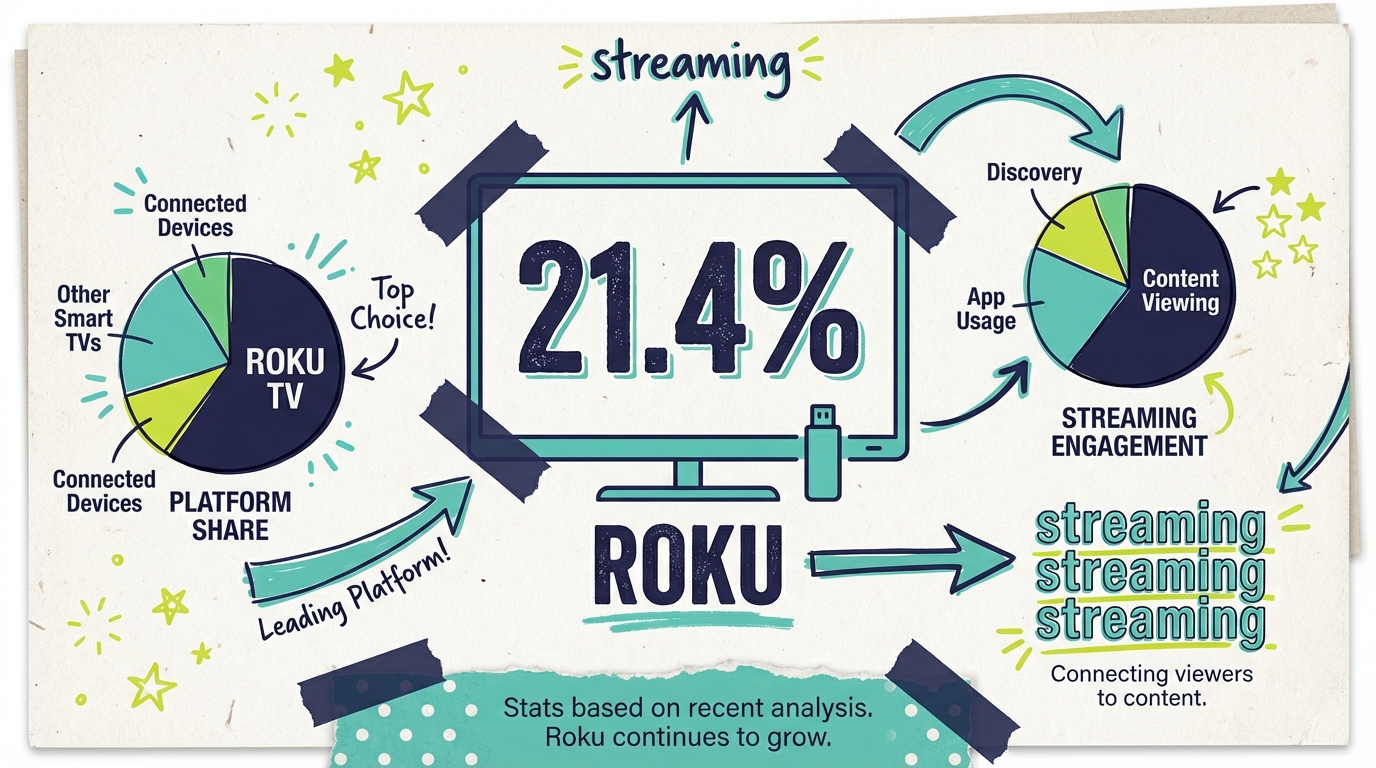
21.4%
All TV viewing on Roku devices
2.8%
The Roku Channel share
>Broadcast
Surpassed broadcast TV (18.4%)
Streaming on Roku-powered devices accounts for 21.4% of all TV viewing in the United States, according to Roku's analysis of Nielsen data. This represents a significant milestone: streaming on Roku now surpasses all broadcast TV viewing (18.4%). Additionally, The Roku Channel, Roku's free ad-supported streaming service, alone captures 2.8% of total TV viewing according to Adweek's coverage of Nielsen data. For advertisers, Roku's dominant platform position creates substantial reach opportunities through multiple advertising touchpoints.
Understanding Roku's position requires distinguishing between two related but different metrics. The 21.4% figure represents all streaming watched through Roku devices (smart TVs with Roku operating system, Roku streaming sticks, and Roku boxes), regardless of which streaming service is being watched. The 2.8% figure specifically measures viewing of The Roku Channel, Roku's own free ad-supported streaming service. Both metrics matter for advertisers, as Roku offers advertising across its platform (home screen, screensavers) and within The Roku Channel's content.
Roku's streaming metrics reveal its dominant position in the connected TV ecosystem.
According to Roku's analysis of Nielsen data, Roku device viewing has reached historic levels:
21.4%: All streaming viewed on Roku devices (as a percentage of total TV viewing)
18.4%: Broadcast TV share (for comparison, Roku surpasses all broadcast)
#1: Roku's rank as a streaming platform by device usage share
>1 in 5: Fraction of all TV viewing happening on Roku devices
The comparison to broadcast television is striking. More Americans watch streaming content through Roku devices alone than watch all broadcast television combined. This shift represents fundamental changes in how Americans consume video content.
The Roku Channel, as a streaming service rather than just a platform, has its own significant viewership:
2.8%: Share of total TV viewing for The Roku Channel
Top free service: Among the largest free ad-supported streaming services
Steady growth: Consistent share gains as free streaming expands
Premium inventory: Free access supported entirely by advertising
The Roku Channel's 2.8% share positions it as a major free streaming destination, comparable to or larger than many well-known streaming services.
Roku's platform reach stems from extensive device penetration:
80+ million: Active Roku accounts in the United States
#1 streaming platform: By time spent and device share in the U.S.
1 in 3 TVs sold: Roku powers approximately one-third of smart TVs sold in North America
Built-in distribution: Roku OS pre-installed on TVs from TCL, Hisense, and others
This device penetration translates directly to advertising reach, as Roku's platform enables multiple advertising touchpoints across its ecosystem.


Understanding why Roku dominates the streaming device landscape reveals opportunities for advertisers.
Roku operates in two distinct ways:
As a platform (21.4%): Roku provides the operating system through which viewers access streaming services. When someone watches Netflix, Hulu, YouTube, or any other app on a Roku device, that viewing counts toward Roku's platform share. Roku earns revenue through advertising on its home screen, screensavers, and through its advertising platform that aggregates inventory across services.
As a service (2.8%): The Roku Channel is Roku's own streaming service, offering free movies, TV shows, and live channels supported by advertising. This content is exclusive to Roku and generates direct advertising revenue for the company.
For advertisers, this distinction matters because different buying approaches access different inventory:
Platform advertising: Home screen banners, screensaver ads, and platform-level placements reach viewers across all content
The Roku Channel advertising: Video ads within Roku's owned content library
Aggregated inventory: Through demand-side platforms, advertisers can access inventory across multiple services accessed through Roku
Several factors drove Roku to its leading position:
Early mover advantage: Roku launched dedicated streaming devices before competitors, building brand recognition and distribution relationships when streaming was emerging.
Smart TV partnerships: By licensing its operating system to TV manufacturers, Roku became the default streaming platform for budget and mid-range smart TVs. Major brands like TCL and Hisense use Roku OS, giving Roku penetration without requiring customers to buy separate devices.
Retailer relationships: Roku devices and Roku-powered TVs have strong placement in Walmart, Best Buy, and Amazon, making them accessible to price-conscious consumers.
Advertising-supported model: Roku's business model depends on advertising revenue rather than device margins, allowing competitive device pricing while building advertising scale.
Content aggregation: The Roku Channel offers substantial free content, giving users value without subscription costs and creating ad-supported viewing inventory.
The Roku Channel has grown through strategic content acquisition and positioning:
Free premium content: Movie and TV content that would cost money elsewhere is available free with ads on The Roku Channel, attracting price-sensitive viewers.
Original content: Roku has invested in original programming to differentiate The Roku Channel and drive viewership.
Live channels: Linear-style channels (similar to cable but free) provide familiar viewing patterns for cord-cutters.
Default positioning: The Roku Channel is prominently featured on Roku devices, reducing friction for discovery compared to requiring app downloads.

Roku's platform dominance and advertising capabilities create practical opportunities for businesses of all sizes.
With 21.4% of all TV viewing happening on Roku devices, advertising on Roku provides significant reach. For small business TV advertising, this means access to millions of households through a single platform.
Roku's reach extends across demographics and geographies. Whether targeting young professionals in urban areas or families in suburbs, Roku's penetration ensures audience availability.
Roku offers various advertising formats:
Video ads: Within The Roku Channel content, standard 15 and 30 second spots
Home screen display: Banners on the Roku home screen seen by all users
Screensaver ads: Ads displayed when devices are idle
Sponsored content rows: Featured content placement in the Roku interface
This variety allows advertisers to build frequency across multiple touchpoints beyond just video advertising.
Roku's advertising platform supports geographic targeting critical for local businesses:
DMA targeting: Reach specific designated market areas
State and regional: Target by state or region
Zip code level: Precision targeting for hyper-local campaigns
For local TV advertising, this geographic precision means advertising dollars reach potential customers rather than being wasted on distant viewers.
The Roku Channel's free ad-supported model represents growing viewership. As consumers seek to reduce streaming subscription costs, free options like The Roku Channel gain viewers. For advertisers, this trend means:
Growing inventory availability
Engaged viewers actively choosing content
Premium content environments without subscription barriers
Efficient reach to cost-conscious consumers
Roku predicts the majority of streaming will eventually be free and ad-supported, positioning its advertising business for long-term growth.
Unlike some premium streaming platforms with high minimum budgets, Roku inventory is accessible through various channels:
Direct with Roku: For larger advertisers with direct relationships
Programmatic: Through demand-side platforms and exchanges
Aggregated platforms: Services like Adwave include Roku inventory alongside other channels, with minimums starting at $50
This accessibility makes Roku advertising viable for businesses of all sizes.


Reaching Roku's audience effectively requires understanding the platform and available strategies.
Multiple paths exist for advertising on Roku:
Aggregated CTV platforms: Services like Adwave include Roku inventory in their channel mix, providing simple access without direct Roku relationships. Start with as little as $50.
Roku advertising directly: For larger advertisers, direct relationships with Roku provide access to the full suite of advertising products including home screen and sponsored content placements.
Programmatic buying: Through DSPs, advertisers can bid on Roku inventory available in programmatic exchanges.
For most small businesses, aggregated platforms offer the simplest path to reaching Roku viewers alongside other streaming audiences.
Effective Roku advertising leverages targeting capabilities:
Geographic targeting: Target by DMA, state, zip code, or radius around a location. Essential for local businesses wanting to reach nearby customers.
Demographic targeting: Age, gender, income, and household composition targeting
Behavioral targeting: Interests, content preferences, and viewing patterns
Content adjacency: Place ads near relevant content categories
Through aggregated platforms, targeting is typically geographic and demographic. Direct Roku buying may offer additional targeting options.
Roku viewing happens primarily on connected TVs, meaning large screen viewing. Effective creative should:
Design for big screens: Bold visuals that work at 50+ inches, not designed for mobile viewing first
Use clear branding: Logo and brand elements visible from across the room
Leverage audio: Sound-on environment means audio carries messaging effectively
Include clear calls to action: Since TV isn't clickable, provide memorable next steps (website, phone, QR code)
AI-powered creative tools from platforms like Adwave can generate TV-quality commercials optimized for Roku viewing.
Roku provides measurement capabilities for advertising campaigns:
Reach and frequency: Track unique household reach and ad exposure frequency
Completion rates: Monitor how many viewers watch ads completely
Attribution: Connect ad exposure to website visits, conversions, and sales
Cross-device: Understand how Roku viewing connects to other device actions
Through aggregated platforms, measurement may be consolidated across all CTV channels rather than Roku-specific.
Roku's dominance reflects broader trends in television and advertising.
Roku's surpassing of broadcast TV viewing marks a watershed moment:
Streaming on a single device platform now exceeds all broadcast networks combined
Younger generations increasingly don't watch broadcast TV at all
Advertisers following audience attention must shift to streaming
For businesses still advertising primarily on broadcast TV, these trends suggest CTV should be part of the media mix.
Roku's free ad-supported model anticipated industry trends now validated by major streamers:
Netflix launched an ad tier in 2022
Disney+ added advertising in 2022
Amazon made Prime Video ad-supported by default in 2024
Max (HBO) offers ad-supported options
Roku was early to the ad-supported model and continues benefiting from the industry shift toward advertising-supported streaming.
Roku's platform position creates durable competitive advantages:
Aggregation value: As a gateway to all streaming services, Roku captures viewing data and advertising opportunities across services
Distribution leverage: TV manufacturers need streaming software; Roku provides it
Advertising scale: Platform reach enables advertising products impossible for individual streaming services
Understanding platform dynamics helps advertisers recognize why Roku remains important even as content competition intensifies.
The broader streaming advertising ecosystem continues attracting investment:
Better targeting and measurement capabilities
Self-serve platforms making CTV accessible
Creative tools reducing production barriers
Growing inventory as more premium content becomes ad-supported
Roku benefits from and contributes to this ecosystem development.


Streaming on Roku-powered devices accounts for 21.4% of all TV viewing in the United States, according to Roku's analysis of Nielsen data. This exceeds all broadcast TV viewing (18.4%). Additionally, The Roku Channel specifically captures 2.8% of total TV viewing, making it one of the largest free streaming services.
Roku as a platform (21.4% share) represents all streaming watched through Roku devices, regardless of which app is used (Netflix, Hulu, YouTube, etc.). The Roku Channel (2.8% share) is specifically Roku's own free ad-supported streaming service with movies, TV shows, and live channels. Both offer advertising opportunities but through different mechanisms.
Roku has over 80 million active accounts in the United States. The company powers approximately one-third of smart TVs sold in North America through its Roku OS licensing partnerships with TV manufacturers like TCL and Hisense. This extensive penetration makes Roku the leading streaming platform by time spent.
Yes, small businesses can reach Roku viewers through aggregated CTV platforms like Adwave, which include Roku inventory alongside 100+ other streaming channels. These platforms offer low minimums (starting at $50) and simple campaign setup. Direct advertising through Roku typically requires larger budgets but provides access to additional inventory types.
Roku offers multiple advertising formats: video ads within The Roku Channel content, home screen display banners, screensaver advertisements, and sponsored content row placements. Through aggregated platforms, video advertising is the primary format available. Direct Roku relationships provide access to the full suite of platform advertising products.
Additional statistics that contextualize Roku's position in the streaming market:
21.4%: All streaming on Roku devices (share of total TV viewing)
18.4%: Broadcast TV share (Roku now exceeds this)
2.8%: The Roku Channel's share of total TV viewing
80+ million: Active Roku accounts in the United States
#1: Roku's rank as streaming platform by time spent
1 in 3: TVs sold in North America powered by Roku OS
45%+: Total streaming share of TV viewing
$15-35: CTV CPM range through aggregated platforms
$50: Minimum budget to start CTV advertising on platforms like Adwave
Data sources:
Ready to reach the 21.4% of TV viewing happening on Roku? Connected TV advertising makes it possible to access Roku and other premium streaming inventory without massive budgets or complex platform negotiations.
Adwave provides access to Roku and 100+ other streaming channels with campaigns starting at just $50. Create professional TV commercials in minutes using AI, then launch targeted campaigns to streaming audiences.
No video production required. No agency fees. No minimum commitments.