Ready in minutes
AI builds your ad from a single prompt


January 23, 2026
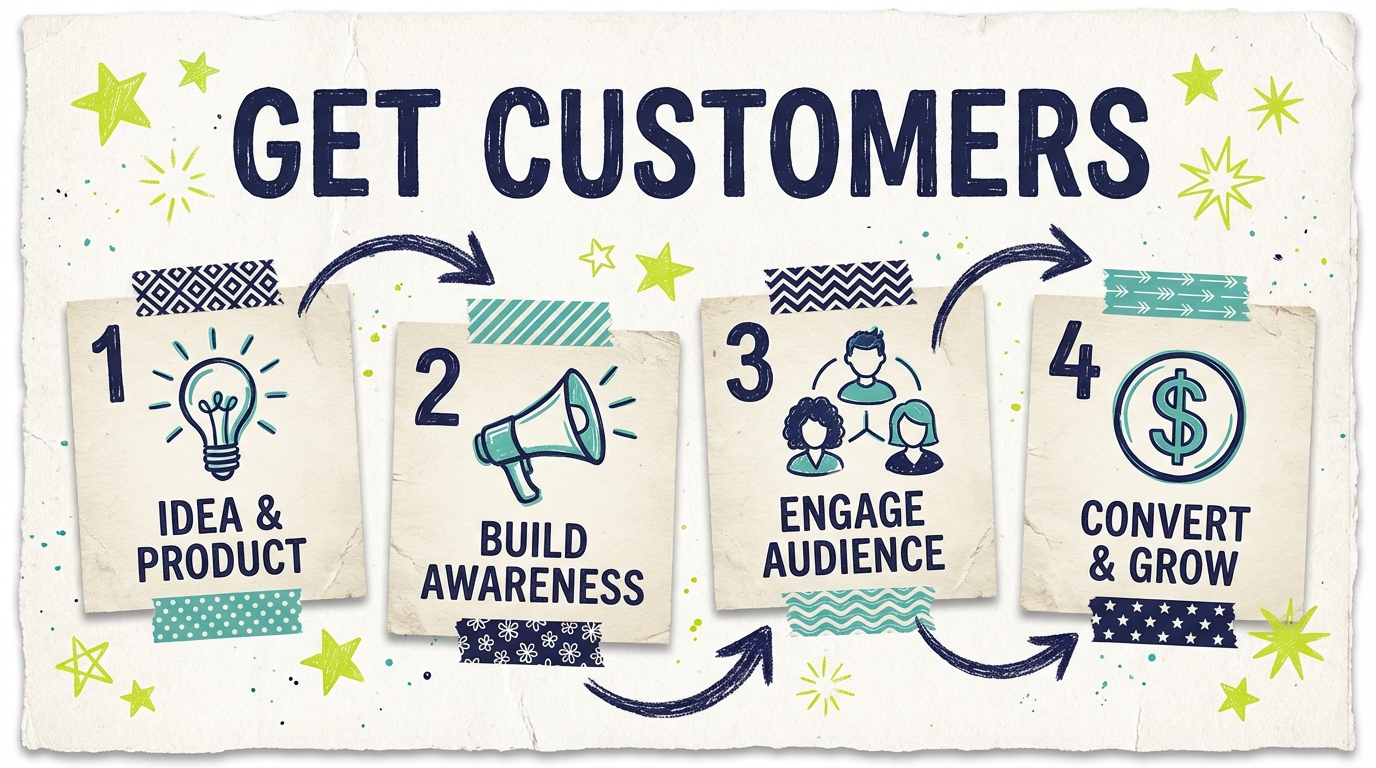
The hardest customers to acquire are your first ones. You have no reviews, no word-of-mouth, no track record to point to. Every startup faces this chicken-and-egg problem: customers want social proof before buying, but you need customers to create that proof.
The good news is that plenty of strategies work specifically for early-stage customer acquisition. This guide covers practical advertising ideas for startups at every stage, from pre-launch to growth mode, with tactics that work at any budget.

Before spending money on advertising, understand why startup marketing differs from established business marketing.
Startups face unique constraints. You're likely working with limited budgets that can't compete with established players in paid media auctions. You haven't figured out your ideal customer profile yet, so targeting is largely experimental. Your product or service may still be evolving based on early customer feedback. And you're racing against time to prove traction before runway disappears.
But startups also have unique advantages. You can move faster than established competitors. You can experiment without bureaucratic approval processes. You can take creative risks that larger companies avoid. And you can build genuine relationships with early customers in ways that scale-obsessed enterprises can't.
The strategies that work best for startups often combine creativity with scrappiness, leverage with experimentation, and paid channels with organic growth tactics.
The most expensive mistake startups make is advertising to the wrong people. Before investing in any paid channel, get crystal clear on who your first customers should be.
Start with your initial target segment. You can't afford to market to "everyone who might want this." Pick a specific group where you have the best chance of success. This might be based on industry, company size, geography, or a specific problem they're experiencing.
Define the early adopter profile. Early adopters aren't just anyone who buys first. They're people who actively seek new solutions, tolerate imperfection, and provide valuable feedback. For B2B startups, this often means innovative companies or forward-thinking individuals within larger organizations. For consumer products, it's people who identify as early adopters in your category.
Understand the buying process. How do people in your target segment discover solutions? Where do they research options? What convinces them to try something new? This knowledge shapes every advertising decision.
Document your value proposition clearly. What specific problem do you solve? What makes your solution different? Why should someone choose an unproven startup over an established alternative? Your advertising needs to communicate this compellingly.

Smart startups start acquiring customers before they even have something to sell. Pre-launch marketing builds the audience you'll convert when ready.
Your pre-launch landing page serves one purpose: capturing interest. Keep it focused with a clear headline that communicates what you're building, a brief explanation of the problem you solve, an email signup form for launch notifications, and optionally, a way to join a waitlist or get early access.
Track who signs up and where they came from. This data informs your post-launch advertising strategy.
Start publishing content that your ideal customers would find valuable, even before your product exists. This builds an audience while establishing expertise.
Write about the problem you're solving, not your solution. Create resources your target audience needs. Share insights from your industry research. Document your building journey if appropriate for your market.
Content takes time to compound, so starting early gives you a head start on organic traffic.
For some startups, transparency about the building process creates genuine excitement. Share progress on social media. Discuss decisions and tradeoffs. Let potential customers feel invested in your journey.
This approach works particularly well for developer tools, creator products, and markets where your target customers appreciate seeing how the sausage is made.
When you're ready to sell, focus on tactics with fast feedback loops. You need to learn quickly what works and iterate.
Sometimes the best advertising is no advertising at all. Especially for B2B startups, direct outreach to potential customers often outperforms any paid channel for early traction.
The key is providing value, not just pitching. Reach out with useful insights. Offer to share research you've done. Ask for feedback on your approach. Build relationships before asking for business.
This doesn't scale forever, but it's often the fastest path to first customers who can become case studies and references.
Your personal and professional networks represent warm leads. People who know you are more likely to trust an unproven startup than strangers would be.
Let everyone know what you're building. Ask for introductions to potential customers. Request referrals to people who might have the problem you solve. Leverage LinkedIn, alumni networks, professional communities, and personal connections.
Many successful startups trace their first customers directly to founder networks.
Find communities where your target customers already gather. This might be Slack groups, Discord servers, Reddit communities, industry forums, or professional associations.
Participate genuinely. Answer questions. Share expertise. Become known as helpful before promoting anything. When you do mention your startup, it comes from an established community member, not a random promoter.
Platforms like Product Hunt, Hacker News, and industry-specific launch venues can generate concentrated attention. These work best when you have something genuinely interesting to show and when your target audience actually uses these platforms.
Don't expect miracles from a single launch. Many successful startups launch multiple times across different platforms as they hit new milestones.

Paid advertising accelerates growth, but it requires careful budget management and rapid iteration.
Search advertising captures existing demand. People already searching for solutions like yours are high-intent prospects. Google Ads and Microsoft Ads let you bid on keywords that signal buying intent.
Start with bottom-of-funnel keywords that show clear intent to purchase or try solutions. Branded terms of competitors can work if your alternative is compelling. Problem-specific searches that your solution addresses provide another avenue.
Keep budgets modest initially. The goal is learning what converts, not scaling immediately.
Social platforms offer powerful targeting for reaching your ideal customer profile. LinkedIn works well for B2B startups, while Meta (Facebook and Instagram) provides broader reach for consumer and SMB-focused products.
For early-stage advertising, focus on driving specific actions like free trials, demos, or email signups rather than general awareness. Test multiple audiences, messages, and creative approaches to find what resonates. Be prepared for experimentation as early campaigns often fail before you find winning combinations.
Start with small budgets ($10-50/day) and increase only when you see promising signals.
Here's something most startup guides won't tell you: TV advertising is now accessible at startup budgets, and it can differentiate you from competitors stuck in the digital-only mindset.
Connected TV (CTV) advertising lets startups run commercials on streaming services like Hulu, Peacock, and Tubi starting at just $50. You can target specific demographics, geographies, and interests without the massive minimums that traditional TV required.
Why would a startup advertise on TV? Several reasons stand out. It builds legitimacy. Prospects who see you on TV perceive your startup as more established and trustworthy. TV also reaches people that digital ads don't, since not everyone is scrolling social media constantly. The format provides impact that makes a 30-second video more memorable than a banner ad. Finally, differentiation matters because while every competitor is fighting for attention in crowded digital channels, TV offers less competition.
With Adwave, you can create a professional TV commercial automatically and launch campaigns on 100+ premium channels with budgets that work for early-stage companies.
Once you're driving any traffic to your website, retargeting becomes your most efficient paid channel. These are people who already showed interest by visiting your site.
Retargeting ads on display networks, social platforms, and even streaming TV keep your startup top of mind as prospects consider their options. Start retargeting campaigns early, even with small budgets.
Content marketing works on a longer timeline than paid ads, but it creates compounding returns that paid channels can't match.
While most startups default to top-of-funnel blog posts, start with content that supports purchase decisions. Comparison pages explaining how you differ from alternatives attract high-intent searchers. Use case content showing how specific customer types use your solution helps too. Implementation guides, integrations documentation, and other resources that help prospects envision using your product all contribute.
This content helps convert traffic you're already generating before expanding to broader topics.
Search engine optimization takes months to show results, but starting early means you'll have organic traffic when you need it most (after paid budgets run thin).
Identify keywords your target customers search when looking for solutions. Create content targeting those keywords. Build your site's authority through quality content and legitimate backlink building.
Don't expect overnight results, but don't neglect this channel either.
Your startup may lack audience, but partners and publications have built theirs. Guest posts on relevant blogs and publications reach established audiences. Podcast appearances put your story in front of engaged listeners. Newsletter sponsorships in publications your target audience reads also help. Co-marketing with complementary startups shares audiences effectively.
Every piece of guest content builds your reach and credibility simultaneously.
Your best customers become your best marketers. Build systems that encourage and facilitate word-of-mouth.
Formalize referral with incentives for customers who bring new customers. The incentive might be discounts, credits, extended features, or even cash for high-value B2B referrals.
Make referring easy with shareable links, clear messaging, and simple explanations of what friends or colleagues get.
Some products spread naturally because using them creates sharing opportunities. Canva designs include a watermark. Calendly invites expose recipients to the product. Slack teams invite colleagues.
Ask yourself: how could using your product naturally introduce others to it?
Early customers who love your product provide the social proof you need to convince later customers. Ask for testimonials actively. Make it easy to leave reviews on relevant platforms. Create case studies from successful implementations.
Use this social proof prominently in all your advertising and marketing materials.
With limited budgets, you can't afford to waste money on ineffective channels. Track performance rigorously.
Focus on metrics that matter for your stage. Customer acquisition cost (CAC) measures what you spend to acquire each customer. Payback period shows how long until a customer generates enough revenue to recover acquisition cost. Conversion rates at each funnel stage identify where you're losing prospects. Channel performance helps you understand which sources produce the best customers.
Run structured experiments rather than random changes. Formulate hypotheses before testing. Change one variable at a time. Track results over statistically meaningful periods. Document learnings even from failed experiments.
The startups that succeed are often those that learn fastest, not those with the best initial guesses.
When you find something that works, invest more before the opportunity disappears. Many startups spread budgets too thin across too many channels. Once you identify a winning approach, focus resources there while continuing small experiments elsewhere.
Learn from others' expensive lessons.
Finding one customer through a channel doesn't mean you've found a scalable acquisition strategy. Many startups increase budgets prematurely, only to find that costs rise faster than results. Prove repeatability before scaling.
Acquiring customers at a loss only makes sense if you have clear line of sight to future profitability. If you don't know your customer lifetime value, you don't know what you can afford to spend acquiring customers.
What works for established companies with brand recognition and big budgets often fails for unknown startups. Focus on scrappy, targeted approaches rather than mass-market campaigns.
The best advertising is a product that retains and delights customers. If customers are churning, no amount of advertising will fix the problem. Prioritize retention alongside acquisition.
Customer acquisition takes time to optimize. Most startups see poor results from early campaigns before finding what works. Budget for experimentation and learning, not just acquisition.
With limited resources, every dollar matters. Here's how to think about allocation.
Focus on free and nearly-free tactics. Direct outreach and personal network leverage cost only time. Community participation and social media posting require effort but no budget. Content creation builds long-term assets. Small retargeting budgets (under $200/month) capture warm visitors.
Add paid experimentation while continuing organic efforts. Test search ads for high-intent keywords. Experiment with social advertising to different audiences. Try TV advertising on streaming platforms for differentiation. Invest in content that will compound over time.
Scale what works while maintaining experimentation. Increase budget on proven channels. Expand geographic or demographic reach. Test additional channels with meaningful budgets. Build brand awareness alongside direct response.
What's the minimum budget needed for startup advertising? You can start acquiring customers with zero advertising budget through direct outreach, content marketing, and community participation. For paid advertising, meaningful experiments start around $500-$1,000/month for search or social, though you can test TV advertising for as little as $50 with platforms like Adwave. More important than budget is having a clear hypothesis and tracking results carefully.
Should startups focus on brand awareness or direct response? Early-stage startups should generally prioritize direct response, meaning advertising designed to generate immediate action like signups, trials, or purchases. You need customers and revenue to survive. Brand awareness matters more once you've proven product-market fit and have budget to invest in longer-term growth.
When should a startup hire a marketing person or agency? Consider hiring or partnering when you've proven a repeatable acquisition motion that needs scaling, when experimentation requires more time than founders can dedicate, or when you need specialized expertise in channels like SEO or paid social. Avoid hiring or outsourcing before you understand your customers and what messages resonate.
How long before advertising starts working? Expect at least 2-3 months of experimentation before finding reliable customer acquisition approaches. Some channels like content marketing take 6-12 months to show significant results. Budget for learning time, not just customer acquisition.
Which advertising channel should startups start with? Start with channels closest to purchase intent. For B2B, this often means direct outreach and search advertising. For consumer products, it depends on where your customers discover new products. Test channels that match how your specific customers research and buy.
Ready to get your startup in front of customers? Create a TV ad that builds credibility and reaches your target audience, starting at just $50.