
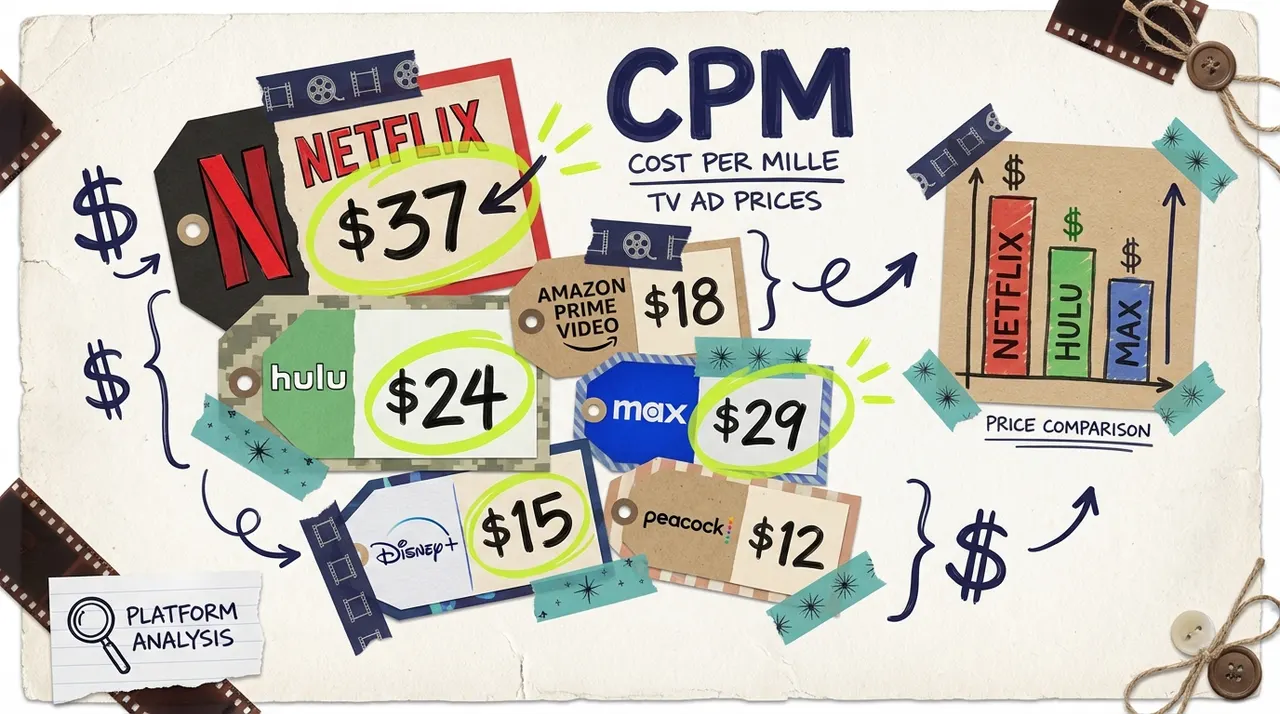
TV advertising CPM is the cost to deliver 1,000 ad impressions on television (linear or streaming). Across major U.S. streaming platforms, the clearest public platform-by-platform table still cited into 2026 comes from Ad Age's streaming commercial pricing analysis of 2024 agency-buying data. In that set, streaming CPMs averaged about $25.68 overall, with a wide spread: Pluto TV ~$14.72 on the low end and Netflix ~$37.02 on the high end. Linear broadcast averaged about $45.34 CPM and cable about $20.60 (Inside Radio reporting on TV upfront data).
Those figures are directional agency averages, not official rate cards. Your real CPM moves with targeting, geography, season, format, and how you buy.
If you are comparing platforms for a first TV buy, start with the table below, then decide whether you need premium brand environment, maximum local reach, or a mix. For a CTV-only average (not platform-by-platform), see our average CTV CPM Q4 2025 update.

Streaming TV CPM by platform (Ad Age agency averages)
Read the table top to bottom as a spread, not as a shopping list. Your buy will rarely sit on a single logo. Most SMB plans blend value inventory for volume with selective mid-tier or premium inventory when brand context matters.
Ad Age analyzed streaming commercial pricing from media-buying agencies. Platforms do not publish a single public rate card, so treat these as benchmarks for planning, not guaranteed quotes.
Source: Ad Age streaming commercial pricing analysis (2024 data; article still widely cited for platform comparisons into 2026). Numbers above are agency averages, not Adwave rate cards.
Quick read of the spread
Use the tiers as planning labels when you brief a buy or compare quotes. They keep conversations about inventory class separate from conversations about creative quality.
Premium (~$30-$40+ in this dataset): Netflix and Max. Higher price, lower ad load positioning, strong brand context.
Mid (~$24-$30): Disney+, Paramount+, Peacock, Prime Video, and often Hulu depending on buy. Scale plus recognizable content.
Value / FAST (~$15-$20): Tubi and Pluto TV. More impressions per dollar, higher ad load environments.
Other planners also quote YouTube CTV in a rough $25-$30 band for TV-screen placements. That figure is a planning range used on related Adwave resources, not a row in the Ad Age table above. Confirm against your buyer or platform before you treat it as a fixed price.
When you read a platform table, remember that agency averages blend many deal types. A national brand buying sponsorship packages will clear differently than a local retailer buying geo-fenced streaming. The ranking of platforms in the table is still useful: premium subscription contexts sit higher, FAST sits lower, and the middle cluster is where many small-business tests land.
If your first question is "what does TV cost," translate every quote into impressions. Write the CPM on a pad, divide your weekly budget by that number, multiply by 1,000, and ask whether that volume can teach you anything in your DMA. That habit beats arguing about logos.

Linear TV CPM context
Streaming is not the whole TV story.
Live sports and tentpole events can price well above those averages. Local linear often has different floors and minimums than national upfront averages. For many small businesses, connected TV vs linear TV is the more useful comparison than national broadcast alone.
Linear still matters for live sports, news, and older audiences that lean on scheduled TV. The catch for small budgets is packaging: national broadcast averages hide high minimums and broad footprints. Local cable can look cheaper on paper and still waste dollars outside your service area. Streaming wins for many SMBs because you can hold geography and measure delivery without buying a full flight of spots you cannot afford.
What CPM does (and does not) tell you
CPM = cost per 1,000 impressions. Example: at a $25 CPM, $500 buys about 20,000 impressions. At $15, the same $500 buys about 33,000. At $37, about 13,500.
CPM does not score audience fit, creative quality, or business results by itself. A lower CPM on the wrong geography wastes money. A higher CPM with tight local targeting can be cheaper per real customer.
Factors that usually raise CPM:
Narrow demo, income, or interest targeting
Premium content or first-position pods
Q4 and other high-demand windows
Interactive or sponsorship formats
Factors that usually lower effective cost:
Broader run-of-network or lighter targeting
FAST inventory when reach is the goal
Off-peak seasons (often Q1)
Geo focus so you stop paying for markets you cannot serve
For format and targeting detail beyond CPM, use our CTV targeting options guide and CTV advertising benchmarks.
Think of CPM as the sticker on the shelf, not the receipt for the trip. Two campaigns can share a $25 CPM and produce very different customers if one wastes half its impressions on the wrong ZIP codes. That is why this page pairs the platform table with budget math and geo-first advice instead of ranking platforms by prestige alone.

How to use this table for an SMB budget
Pick the job. Awareness and name recognition can lean FAST (Tubi, Pluto). Brand-safe premium context leans Netflix/Max-style inventory. Most local tests land in mid-tier mix.
Translate budget to impressions. Budget ÷ CPM × 1,000. Keep a sticky note with $15 / $25 / $35 so you can sanity-check quotes.
Geo first. If you serve one DMA or a radius around a store, prioritize buys that can hold geography. National averages hide a lot of waste for local businesses.
Test in bands, not one logo. A Tubi or Pluto TV heavy flight plus a mid-tier flight teaches you more than debating Netflix on day one.
Watch completion and outcomes, not only CPM. CTV completion is typically very high versus skippable social video. Compare apples to apples when you stack TV against Meta or YouTube.
Rough starting bands many SMBs use when they plan through a self-serve buyer:
$50-$200 total test: Bias to value/FAST for learning volume.
$200-$500: Mix FAST + mid-tier.
$500+: Add selective premium if brand context matters.
A practical weekly rhythm helps. Spend the first week learning delivery and creative completion in-market. Spend the second week adjusting geo and creative. Only then argue about whether premium inventory is worth the lift. Most first TV buys fail because the operator changes three variables at once, not because the platform table was wrong.
If you already run Meta or Google, treat TV as an attention layer that makes those channels work harder. Search lift and branded query movement often show up before last-click conversions do. Plan measurement that way so you do not kill a TV flight that was doing brand work your click reports miss.
Adwave runs multichannel campaigns (including TV) from $30/day, with a prepaid daily budget you control. Individual signups typically get a $60 starter credit. If you need spot creative, Wavemaker is the creative tooling home; keep media buying and reporting in Adwave.

Why platform CPMs moved (short version)
Ad Age's set showed a ~21% drop in average streaming CPM year over year in that 2024 agency sample, with Netflix down hard as ad-tier inventory grew and Prime Video entered the ad market at a lower reference point (~$24 in that dataset). More ad-supported subscribers usually means more available impressions. That supply story is why mid-2020s streaming CPMs look more reachable for small budgets than the old "TV is only for national brands" folklore.
Expect stabilization more than endless free fall. Live sports on streaming, election years, and Q4 still create spikes. Use the table as a map, then price the buy you run.
For operators, the takeaway is simple. Streaming TV is no longer priced only for national brands. The same table that once felt out of reach now includes value tiers that can fund a local learning flight. Keep premium inventory in the mix when brand context matters, and keep FAST in the mix when you need volume to learn creative and geo.
FAQ
What is a good TV advertising CPM?
For streaming/CTV planning, many SMB campaigns land around $20-$35, with FAST often nearer $15-$20 and premium platforms higher in the Ad Age averages above. Linear broadcast averages were near $45 in the Inside Radio figures cited here; cable nearer $20. "Good" means you reach the right people at a cost your margin can support, not the lowest cell in a table.
Why is Netflix CPM higher than Pluto TV?
In the Ad Age agency averages, Netflix sat near $37 and Pluto TV near $15. Premium subscription contexts, content mix, and lower ad-load positioning usually price higher than free ad-supported (FAST) inventory. Different audience and environment, different rate.
Are higher CPM platforms worth it?
Sometimes. If you sell a high-trust or premium offer and care about adjacent content, paying up can make sense. If you need local reach on a tight budget, FAST and mid-tier often win on impressions per dollar. Test both when you can.
How do CTV CPMs compare to social video?
Social video CPMs are often lower in nominal dollars (commonly cited in rough $5-$15 bands depending on platform and auction). CTV usually costs more per thousand but runs full-screen, sound-on, with very high completion versus many skippable feeds. Compare cost per completed view and business results, not CPM alone. See connected TV vs social media ads.
Can a small business afford these CPMs?
Yes, if you buy locally and size the budget to learning. At ~$25 CPM, $500 is about 20,000 impressions. Adwave lets you start from $30/day without needing a six-figure media retainer. Pair that with clear geo targeting so spend stays in market.
The other affordability lever is creative. A clear 15- or 30-second spot with a local offer beats a polished national-looking ad that never says where you are. Build the spot so a stranger in your DMA knows what to do next, then let CPM math decide how long the flight can run.
Where should I go next?
Platform hubs: Tubi, Pluto TV, CTV advertising platforms
Cost siblings: average CTV CPM (Q4 2025), how much does it cost to advertise
Buying context: programmatic video advertising


