Ready in minutes
AI builds your ad from a single prompt


April 18, 2025
YouTube captures 12.5% of total TV viewing, leading all streaming platforms.
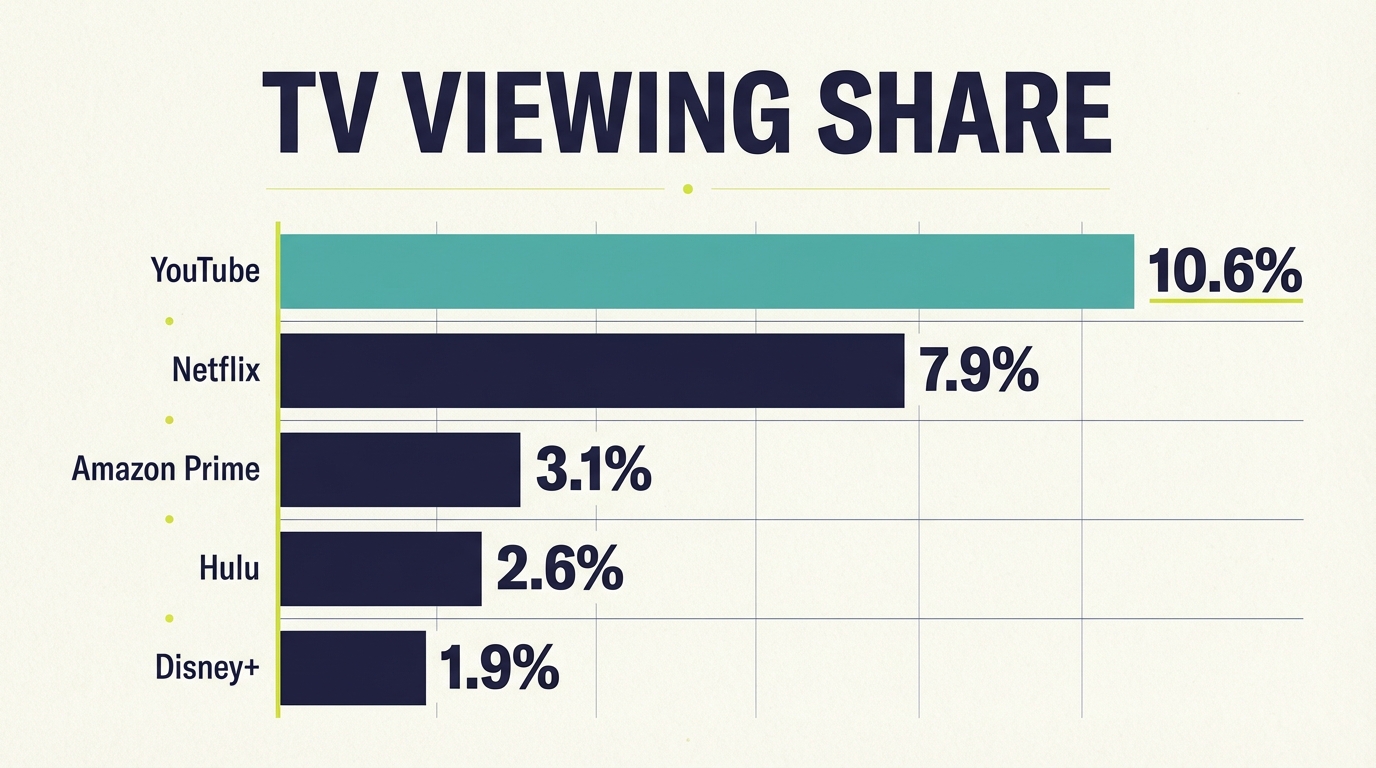
10.6%
YouTube's share of total U.S. TV viewing
#1
Largest streaming platform by viewing share
+120%
Growth in YouTube TV viewing since 2021
YouTube commands 12.4% of total U.S. TV viewing time, making it the single largest streaming platform by viewing share, according to Nielsen's April 2025 Media Distributor Gauge report. That means YouTube now commands more TV attention than Netflix, Hulu, Disney+, or any other streaming service. For the third consecutive month, YouTube has maintained its lead among media companies, capturing the attention of millions of Americans on the biggest screen in the house.
This dominance represents a seismic shift in how Americans consume video content. Just five years ago, YouTube was primarily associated with mobile phones and laptop screens. Today, it has become the centerpiece of living room entertainment, fundamentally reshaping the advertising landscape and creating unprecedented opportunities for businesses of all sizes to reach audiences through TV advertising.
For small business owners who have always assumed TV advertising was out of reach, this shift opens new doors. Where traditional TV advertising required six-figure budgets and agency relationships, connected TV advertising now makes it possible to reach these same audiences starting at just $50.
The numbers behind YouTube's TV dominance tell a compelling story of rapid growth and sustained leadership in an increasingly competitive streaming landscape.
According to Nielsen's Gauge reports for 2025, here's how YouTube's TV viewing share has evolved:
12.4% share in April 2025: YouTube's highest share recorded at that time, representing audiences' time spent watching TV
13.4% share in July 2025: YouTube reached its peak share mid-year, according to Variety's Nielsen analysis
12.6% share in September 2025: A slight pullback but still commanding a dominant position per VideoWeek reporting
+2.8 percentage points YoY growth: YouTube's share increased by 2.8 points compared to April 2024, according to NetInfluencer's analysis
4-point lead over Disney: YouTube widened its lead over second-place Disney (9.4%) by 4 share points according to MediaPlayNews
11.6% share in February 2025: YouTube moved to the top spot earlier in the year according to Hollywood Reporter
To put these numbers in perspective, the entire streaming category represented 44.8% of TV viewership in May 2025, which Nielsen reported as a historic milestone when streaming eclipsed combined broadcast (20.1%) and cable (24.1%) viewing for the first time. YouTube alone accounts for more than a quarter of all streaming viewership.
The platform's growth trajectory is particularly impressive when you consider the competitive landscape. YouTube isn't just competing with other streaming services; it's winning against Netflix, Amazon Prime Video, Hulu, Disney+, and dozens of other platforms all vying for viewer attention. The fact that a free, ad-supported platform has emerged as the leader speaks volumes about changing consumer preferences and the effectiveness of YouTube's content strategy.
For advertisers, this means YouTube on TV represents one of the largest audiences available for video advertising, rivaling or exceeding the reach of traditional broadcast networks during prime time.


Understanding who watches YouTube on TV is just as important as knowing how much they watch. The platform's audience demographics reveal valuable insights for advertisers and marketers.
YouTube's TV audience skews younger than traditional television, but the platform has significant reach across all age groups:
15.7% of users are aged 18-24: Young adults who grew up with YouTube
21.5% are aged 25-34: YouTube's largest demographic segment according to DemandSage
17.9% are aged 35-44: Mid-career professionals and young families
12.9% are aged 45-54: An often-overlooked but significant segment
9.4% are aged 55-64: Baby boomers increasingly adopting streaming
According to Global Media Insight's YouTube statistics, the 25-34 age group represents YouTube's largest audience segment worldwide. This is particularly valuable for advertisers because this demographic is often considered the most desirable for marketers: they have disposable income, are forming brand loyalties, and are highly engaged digital consumers.
YouTube's audience composition shows a slight male skew, though the platform reaches both genders effectively:
54% male users: A slight majority of YouTube's viewing population
46% female users: Significant reach among women as well
This relatively balanced gender distribution makes YouTube an effective platform for reaching broad audiences, whether you're marketing products or services aimed at men, women, or mixed households.
The shift to TV viewing represents a fundamental change in how people consume YouTube content:
Living room viewing dominates: More YouTube content is now consumed on TV screens than ever before
Shared viewing experiences: Unlike mobile, TV viewing often involves multiple household members
Longer viewing sessions: TV viewers typically watch for longer periods compared to mobile users
Prime time competition: YouTube now competes directly with traditional TV programming for evening attention
For small business TV advertising, this means your YouTube ads can reach viewers in the most impactful context: relaxed, attentive, and watching on a large screen.
What are people watching on YouTube via their TVs? The content mix differs from mobile viewing:
Long-form content: Documentaries, vlogs, and educational content perform well on TV
Music and music videos: Background entertainment for households
Sports highlights and commentary: Particularly popular among male viewers
Kids' content: YouTube remains a go-to for children's entertainment
Podcasts and talk shows: Audio-visual podcasts gaining TV traction

YouTube's dominance in TV viewing creates specific opportunities and implications for businesses, especially small and medium-sized companies that have traditionally been priced out of television advertising.
For decades, TV advertising was reserved for brands with massive budgets. A national TV campaign could easily cost millions of dollars, and even local cable advertising required tens of thousands. YouTube's rise as the top TV platform has coincided with the democratization of TV advertising through connected TV (CTV) platforms.
Today, platforms like Adwave allow small businesses to run TV ads on premium channels, including YouTube, starting at just $50. This represents a fundamental shift in who can access TV audiences.
One of the most significant advantages of advertising through YouTube and other streaming platforms is the ability to reach audiences who are increasingly difficult to find through traditional TV:
Cord-cutters: Households that have cancelled cable or satellite subscriptions
Cord-nevers: Younger viewers who never subscribed to traditional TV in the first place
Light TV viewers: People who watch sparingly but engage heavily with streaming
According to cord-cutting statistics, streaming now represents over 47% of all TV viewing time. If your target audience includes anyone under 50, you likely need a streaming strategy to reach them effectively.
YouTube viewers on TV represent a particularly valuable audience for several reasons:
Active choosing: Unlike traditional TV where viewers might passively watch whatever is on, YouTube viewers actively choose content
Lean-in engagement: The large screen format encourages focused viewing rather than second-screen behavior
Less ad fatigue: With fewer ads than traditional TV, each ad exposure carries more weight
Skip-resistant formats: YouTube's non-skippable ad formats ensure your message gets delivered
One of YouTube's unique advantages for small businesses is the combination of massive scale with precise targeting capabilities. You can reach millions of potential customers while still targeting specific:
Geographic areas: Target by ZIP code, city, or DMA
Demographics: Age, gender, household income, and more
Interests: Based on viewing behavior and content preferences
Life events: Reaching people during key purchasing moments
This combination makes YouTube an ideal platform for local TV advertising that can compete with national brands for local attention.


Understanding YouTube's TV dominance is one thing; capitalizing on it is another. Here's a practical guide for businesses looking to tap into this massive audience.
Before investing in YouTube TV advertising, take time to understand if your target audience aligns with YouTube's demographics:
Best fit: B2C products and services, local businesses, e-commerce brands, restaurants, real estate, automotive, healthcare
Consider carefully: B2B services with narrow enterprise targets (though YouTube can still work for brand awareness)
Think about context: What content might your ideal customers be watching?
There are several ways to advertise on YouTube through TV screens:
Direct YouTube Ads (Google Ads)
Requires Google Ads account and creative expertise
Offers precise targeting and bidding control
Can be complex for beginners
Higher minimum budgets typically needed
Connected TV platforms (like Adwave)
Simplified interface for small businesses
Access to YouTube and 100+ other channels
AI-powered ad creation (no video production needed)
$50 minimum budget to start
For most small businesses, starting with a CTV platform provides the easiest entry point with the lowest risk.
YouTube TV ads need to work on the big screen. Consider:
Clear visuals: Ensure text and images are readable from across the room
Strong audio: Many TV viewers watch with sound on (unlike mobile)
Compelling hook: You have seconds to capture attention
Clear call-to-action: Tell viewers exactly what to do next
Appropriate length: 15-30 second spots work best
Don't have video? Platforms like Adwave use AI to create professional TV commercials from your existing assets.
Getting started with YouTube TV advertising doesn't require a massive budget, but it does require realistic expectations:
$50-$100: Test the waters, gather data, learn what works
$200-$500: Run a meaningful two-week campaign with measurable results
$500-$2,000/month: Sustained presence with consistent brand building
Remember that TV advertising, including YouTube, works best for brand awareness and consideration. Don't expect direct-response metrics like those from search ads.
Track these metrics to understand your YouTube TV advertising performance:
Impressions: How many times your ad was shown
Completion rate: How many viewers watched your entire ad
Brand lift: Changes in brand awareness and consideration
Website visits: Traffic increases correlated with campaign timing
Store visits: For local businesses, foot traffic changes
YouTube's rise to TV dominance is part of a larger transformation in how Americans consume video content. Understanding this broader context helps explain why this trend matters and where it's heading.
In May 2025, streaming achieved a historic milestone: for the first time ever, streaming viewership (44.8%) exceeded the combined total of broadcast (20.1%) and cable (24.1%) television. This wasn't a temporary blip; it represented the culmination of a decade-long shift in viewing habits.
YouTube's position at the top of this streaming hierarchy is particularly significant because:
It's free and ad-supported: Unlike Netflix or Disney+, YouTube's growth hasn't been limited by subscription barriers
It's infinitely diverse: From professional content to user-generated videos, YouTube offers something for everyone
It's already on every device: Years of platform development mean YouTube is pre-installed on virtually every smart TV
For the advertising industry, YouTube's TV dominance has profound implications:
Shifted attention: Ad dollars are following viewers from traditional TV to streaming
New measurement challenges: Traditional TV metrics don't directly apply to streaming
Democratized access: Smaller advertisers can now compete for TV attention
Changed creative requirements: Ads need to work in both skippable and non-skippable contexts
According to CTV advertising statistics, connected TV ad spending continues to grow at double-digit rates as advertisers recognize where audiences have moved.
Several trends suggest YouTube's TV dominance will continue:
Smart TV penetration: As more households upgrade to smart TVs, YouTube access becomes even more universal
Content investment: YouTube continues investing in premium content and creator partnerships
Advertising effectiveness: Early results show CTV ads deliver strong ROI, encouraging more ad spend
Generational habits: Younger viewers who grew up with YouTube will carry these habits forward
For small businesses, the message is clear: YouTube on TV is not a niche or experimental channel. It's mainstream, and it's where your customers are increasingly spending their attention.


Industry analysts and marketing experts have taken note of YouTube's TV viewing dominance, offering perspectives on what it means for advertisers.
Barrett Media reported that "YouTube held its position as the top media company in Nielsen's April 2025 Media Distributor Gauge report, capturing 12.4% of audiences' time spent watching TV." The publication noted this represented the platform's highest share to date at that time.
The Hollywood Reporter observed that "YouTube moved to the top spot in February's media distributor rankings from Nielsen, scoring 11.6 percent of all TV use in the U.S." This marked an important inflection point as YouTube surpassed traditional media companies.
Nielsen's own analysis highlighted that YouTube's growth has been particularly impressive among younger demographics, with the platform serving as a primary TV source for viewers under 35. This suggests the trend will only strengthen as these viewers age and increase their overall TV consumption.
Marketing experts recommend that advertisers treat YouTube as a core TV channel rather than a separate digital platform. The viewing context (big screen, living room, often shared viewing) means YouTube TV ads function more like traditional TV spots than like mobile video ads.
YouTube (12.4%) has surpassed Netflix (7.8%) as the largest streaming platform by TV viewing share, according to Nielsen's April 2025 data. YouTube's lead is approximately 4.6 percentage points, making it the clear leader among streaming services. Netflix remains strong in subscription-based streaming, but YouTube's free, ad-supported model has allowed it to capture a larger overall audience.
Yes, absolutely. While direct YouTube advertising through Google Ads can be complex, connected TV platforms like Adwave make it possible for small businesses to reach YouTube viewers (and viewers on 100+ other streaming channels) starting at just $50. No video production experience is required, as AI tools can create professional commercials from your existing business assets.
YouTube TV CPMs typically range from $15-35 depending on targeting, seasonality, and ad format. This is competitive with traditional TV advertising and often more efficient because of better targeting capabilities. For CTV advertising, you can expect similar ranges when accessing YouTube through programmatic platforms.
YouTube's TV viewing share has been consistently growing. The platform gained 2.8 percentage points year-over-year from April 2024 to April 2025. While there are normal monthly fluctuations (a slight dip in September 2025, for example), the overall trend remains strongly upward. As smart TV adoption continues and streaming habits solidify, YouTube's TV presence is expected to grow further.
For YouTube TV advertising, 15-30 second spots typically perform best. Non-skippable formats ensure viewers see your complete message, while shorter lengths maintain attention and reduce production costs. For brand awareness campaigns, 30 seconds allows enough time to tell a story; for direct response, 15 seconds can be highly effective.
Additional statistics and research that support YouTube's TV viewing dominance:
2.5 billion monthly users: YouTube's global monthly active user base according to company data
1 billion+ hours watched daily: Total daily YouTube viewing across all devices globally
100+ countries: Markets where YouTube is available
80 languages: Languages supported by the YouTube platform
70% of YouTube watch time: Comes from mobile devices globally, but TV is the fastest-growing screen
$31.5 billion: YouTube's advertising revenue in 2023, according to Alphabet earnings
#2 search engine: YouTube is the second-largest search engine after Google
500 hours of video uploaded per minute: Content volume added to YouTube continuously
For current CTV and streaming advertising data, see Adwave's CTV Advertising Statistics 2025.
Data sources used in this article:
YouTube's dominance in TV viewing isn't just a statistic; it's an opportunity. For the first time, small businesses can reach the same massive TV audiences that were once exclusive to Fortune 500 brands.
Adwave makes TV advertising accessible for businesses of all sizes. Create a professional TV commercial in minutes using AI, then launch it across YouTube, Hulu, Peacock, and 100+ premium channels starting at just $50.
No video production experience required. No massive budgets. No agencies.